The Upper House Hong Kong Review: A Poetic Stay Above Victoria Harbour
Standing by the window and looking out over Hong Kong, one momentarily forgets the identity of being a traveler. It begins to feel as though this place is not somewhere one simply passes through, but rather a point where one’s present and future intersect. Perhaps it is the immersive sense of calm that the space provides—despite not being home, it feels like one belongs here, as if one has always been part of it.

A Completely New Definition of a Hotel: The Upper House Hong Kong
Victoria Harbour in Hong Kong. A place shaped by countless collisions and exchanges between East and West, layered with the traces of time. The paths of boats gliding across its surface seem to prove the ambition of this city. Between the sunlight breaking across the morning waves and the dazzling lights filling the night skyline, there comes a feeling that I, too, am living as a part of Hong Kong. The rooms at The Upper House exist right on that threshold. While the city outside continues to move intensely, everything inside is distilled into something almost like a still image. I would like to introduce the three days I spent in this space, where a stay takes on a special meaning.

A Hotel’s Intent, Revealed Through Check-in
The Upper House Hong Kong is currently one of the hottest hotels in the world. It ranked No.10 in the World’s 50 Best Hotels 2026. Located in the heart of Admiralty, surrounded by dense high-rise buildings, it sits above Pacific Place. The quietness unique to this place carries a peculiar tension, as if it is floating above the very center of the city.
To understand this hotel, the first name that must be mentioned is Andre Fu. This Hong Kong-born designer is regarded as someone who designs not just spaces, but a way of living through spatial design. Through this project, he gained international recognition and has since become a leading figure shaping the direction of luxury hotel design around the world. His philosophy is clear: rather than relying on excessive decoration or displaying brands, he realizes ultimate luxury through “restrained calmness.” This philosophy continues consistently across many of his later projects in cities such as London, Tokyo, and Shanghai. But its origin undoubtedly lies here, at The Upper House.
What I felt while staying at The Upper House was that this place is an attempt to redefine the very genre of a “hotel.” At its core lies a question: how can space make a person feel calm and at ease?
When designing The Upper House, Andre Fu deliberately stepped away from the concept of creating a conventional “hotel.” His approach was much closer to something private. He imagined this space as a kind of “urban residence.” It is not a place where guests simply stay temporarily, but a space where they can rediscover their own rhythm of life, even if only for a short time. To realize this concept, he integrated circulation, materials, light, sound, and even the flow of emotions into a single residential experience.
The Hotel’s Intent, Seen Through Check-in
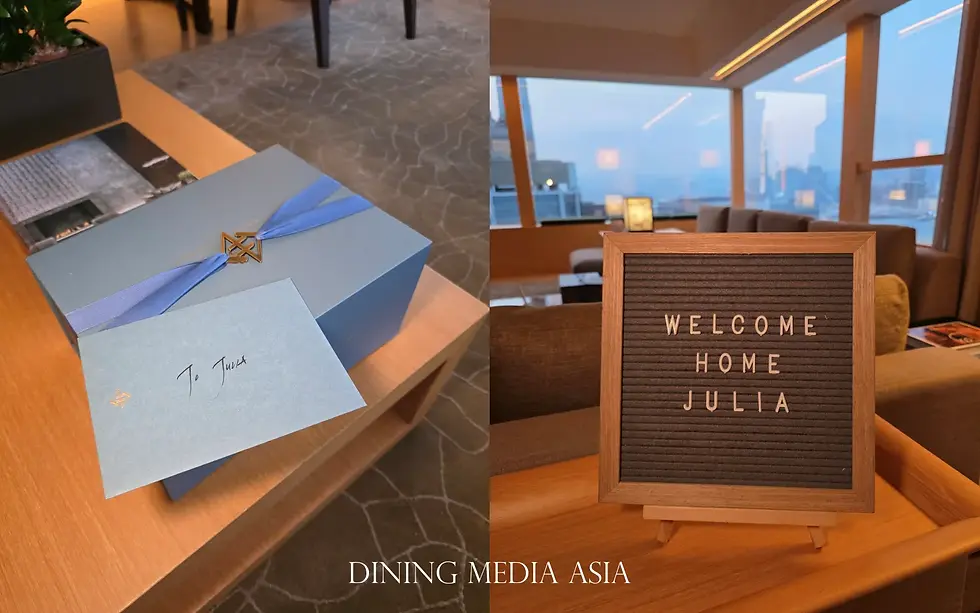
One particularly striking aspect is the check-in experience upon arrival. While many hotels design grand and imposing lobbies to deliver an immediate and powerful impression, The Upper House intentionally delays the experience. What might be called a lobby is merely a small table with two computers, performing only the most minimal function. Instead, after a simple confirmation at the entrance, guests are guided by the concierge through a long and quiet transition. They take the elevator up, walk through softly lit corridors, and gradually disconnect from the outside world. Check-in itself is completed smoothly and naturally in the room. Guests are guided upstairs, where they finish the check-in process and receive explanations within the privacy of their own space. It is efficient, but more importantly, it is a gesture that brings the guest directly into their own domain rather than integrating them into a shared system. Through this process, a shift in the senses is intentionally created. One moves away from the fast rhythm of the city, gradually shedding speed and finding one’s own place. This “slow arrival” is perhaps one of the most important psychological devices designed by Andre Fu.

Design Details with Philosophy by Andre Fu
Interestingly, much like its name, The Upper House is designed around vertical movement—going upward, higher and higher. Physically located at a high level, this verticality itself becomes part of the narrative. The tall atrium that runs through the building draws natural light from above, giving depth to the entire space. Light acts almost like the passage of time, subtly changing the expression of the space throughout the day. It creates a sensation of gradually leaving the ground behind and moving toward a quieter realm.
There is also an underlying Eastern sensibility embedded in the space. It is not a direct reproduction of tradition, but rather a contemporary translation of its spirit. The softly diffused light from the ceiling, the tactile quality of the materials, and the tension created by empty space all contribute to this feeling. Through these elements, Andre Fu does not divide past and present, or East and West, but integrates them into a single sensory experience.

The selection of materials is another key to understanding his design. Instead of using flashy or ostentatious materials, the space is built around elements derived from nature. Wood, stone, lacquer, paper, and glass are repeatedly used, all coming to life through their relationship with light. The bathroom lighting at night, in particular, is truly beautiful. Light is absorbed or reflected through these materials, allowing the space to continuously change throughout the day. It is not a static environment, but one that moves with time.


The rooms themselves reveal a strong sense of residential living. The placement of furniture, the flow of movement, and even the direction of sightlines all suggest the logic of long-term habitation. The color palette is extremely restrained, dominated by calm and bright wood tones, avoiding strong contrasts. This choice is closely tied to the relationship with the external city of Hong Kong. The quieter the interior, the more vividly the outside city is revealed. In other words, the interior does not try to assert itself, but instead functions as a frame for the view. Many of the windows capture scenes that feel almost cinematic. The window frames and the interior space act like a canvas supporting the landscape of Hong Kong. The skyline unfolds like a painting—the reflections shimmering on Victoria Harbour, the rhythm of densely packed buildings, and the movement of boats cutting through them. Whether lying in bed or soaking in the bathtub, the exterior city and the interior space naturally connect.
The decision to eliminate traditional public spaces such as a grand lobby or swimming pool and instead focus on the rooms feels almost like a declaration about space itself. There is no “meeting place” where one drinks tea under a chandelier or holds important business meetings. Instead, it proposes a luxurious “place to stay,” like the residence of a global CEO in Hong Kong. Interaction with others is minimized, while one’s personal time and sensory experience are maximized. It feels more like a private apartment than a hotel. The moment you open the door and step inside, the space becomes entirely your own. And within that quietness, the presence of the city becomes even more distinct.

“Room-Centric Hospitality” — Bringing Everything Into Your Private Space
The hospitality style is equally unique. It differs significantly from the traditional grammar of luxury hotel service, focusing instead on understanding the individual rhythm and preferences of each guest. As mentioned earlier, this is not a “lobby-centered hospitality” model, but a “room-centered hospitality” approach. The room becomes not only a place to stay, but the private stage where service truly begins. Check-in, explanations, rest, wellness, and even parts of dining all unfold within this personal space. Instead of a spa facility, a variety of wellness programs—such as massages, facials, nail services, and styling—are offered in-room. This is possible because even the smallest room in the hotel is spacious enough to accommodate a spa bed, comparable in size to suites in other luxury hotels.
What makes the service at The Upper House distinctive is that it is understood not as a technique of “displaying” service, but as a technique of removing inconvenience. Hospitality is not confined to a specific department—every staff member operates with the same tone and attitude. Even maintenance staff naturally greet guests and offer assistance, demonstrating how organically the service system functions. The key lies in creating an experience tailored to each individual traveler, which requires careful observation and a willingness to find solutions in any situation. Personally, I do appreciate traditional butler-style luxury service, but here, I found a different kind of comfort and impression in a system where the experience remains consistent regardless of whom you encounter. Service is not hierarchical or ceremonial, but rather flows through a small, unified team that supports the guest’s stay. Each staff member fulfills their role while also responding flexibly based on their own judgment and sensitivity.

Wellness was also particularly interesting. The Upper House does not have a large spa facility. Instead, it offers a more personalized approach through a 24-hour fitness space, yoga and meditation programs, and a range of treatments conducted in the room. Sound baths, guided meditation, yoga, and longevity-focused therapy programs are offered on a rotating basis. During my stay, I experienced an “anti-aging program,” which included 45 minutes in a hyperbaric oxygen chamber, followed by a cold plunge and sauna routine. It felt less like a hotel experience and more like a glimpse into the lifestyle of someone running a multi-billion-dollar company in Hong Kong—where such wellness practices are part of everyday life. While excellent massages are always appealing, this kind of lifestyle-focused anti-aging program felt especially aligned with The Upper House.
Beyond that, the in-room minibar is designed like a home space that guests can freely enjoy. A variety of snacks and beverages are included, and aside from certain alcoholic items like wine, most are complimentary. The rooms eliminate single-use plastics, providing water through a filtration system, and bathroom amenities are offered in reusable containers. Across the restaurant and shared areas, operations also consider energy efficiency and resource conservation. These choices go beyond environmental protection—they reflect the values and attitude the hotel aims to embody.
The digital system is also highly refined. Through a QR-based service system, guests can easily access room service, restaurant reservations, and various requests. This reduces unnecessary face-to-face interactions while providing a high level of convenience. Technology does not present itself overtly, but instead functions as an invisible foundation that minimizes friction in the service experience.

Overall, the three days spent here made it clear that this is not “luxury designed to be shown,” but “luxury designed to be felt.” Service does not step forward, yet it is present in every moment, creating a consistent experience. It feels as though this rhythm and this way of being had always existed within me. A special “house” experience in Hong Kong. It led me to ask myself a question: what is luxury, really? Is it about having more—bigger, more extravagant, more abundant? Or does it begin with removing things instead? The answer proposed by The Upper House was, surprisingly, deeply convincing.
댓글