The Ultimate Expression of Maximalism: JW Marriott Phu Quoc Emerald Bay Resort & Spa
최종 수정일: 9월 4일
Perhaps the hardest thing in the world to recreate is the aura of history. At JW Marriott Phu Quoc Emerald Bay Resort & Spa, set along Khem Beach on the southern coast of Vietnam’s Phu Quoc Island, I encountered maximalism at its most extraordinary.

From Phu Quoc International Airport, where I landed on a late-evening direct flight, it was just over 20 minutes to the hotel. The moment I arrived at the lobby, however, I sensed something distinctly unexpected. Instead of the neutral beige marble typical of a luxury resort, I was greeted by architecture reminiscent of the entrance to an old university, arched corridors, seemingly time-faded hues, curious animal specimens, antique books, and crests and emblems evoking the world of academia. The walls are lined with materials recounting the university’s history, while display cabinets hold objects that appear to have been painstakingly collected over decades. Even the terminology used by the staff and the names given to the buildings make it seem unmistakably as though this were, in fact, a university transformed into a resort.

The university is called Lamarck University. But there is a twist: it never actually existed. According to the hotel’s own narrative, the university was founded in 1894 in honour of the French naturalist Jean-Baptiste Lamarck, closed its doors in the 1940s, and was left abandoned for decades before eventually being restored by JW Marriott. In reality, the entire story is fictional. Yet every detail is executed with such extraordinary conviction that the fiction never quite feels fictional. Instead, the resort draws us into its imagined history with remarkable precision and an almost obsessive attention to detail.

Now, let’s immerse ourselves more fully in this fictional world. Lamarck lived before Charles Darwin and was among the early thinkers who attempted to explain how living organisms change and evolve. While his theories are no longer accepted in their entirety by modern science, he is nevertheless regarded as an important figure in laying the foundations for modern evolutionary thought. (Doesn’t it all sound remarkably plausible?)
Bill Bensley, the designer behind the hotel, imagined this fictional university as an institution devoted to the study of nature and humanity, biology, anthropology and zoology. The guestroom buildings, restaurants, bars, spa and recreational facilities were conceived as different academic departments and university facilities—although, quite frankly, it feels less like a “concept” than an actual historic campus that has been painstakingly restored. Every vintage piece of furniture, framed picture and decorative object feels utterly committed to the story. True to the idea of “rebuilding a dream university dedicated to the study of all things natural,” the narrative extends into the proportions and colours of the buildings, the furniture and artwork, the door handles, staff uniforms, wayfinding signs and even the names of the restaurants. It is the kind of conceit that, handled poorly, could so easily become kitsch or contrived. Here, however, the fiction takes on the weight of reality, as though a genuine historic campus had simply been rediscovered and brought back to life.
The way one experiences the hotel follows the same logic. Even the walk to your room becomes an exploration of the campus. Following signs illustrated like weathered old maps, you pass buildings belonging to different “departments” and encounter unexpected objects tucked between arcades, staircases and gardens. This is a hotel that rewards taking the long way around: peering into a specimen cabinet beneath a staircase, stopping to read a small inscription on a wall, or simply allowing yourself to wander without purpose. It is through these seemingly incidental discoveries that the story of the place gradually becomes complete.

Bill Bensley: Master of Maximalism, Devil in the Details
In our world, he is an icon: Bill Bensley. If you have even a passing interest in travel and hotels, his is a name you will inevitably encounter. There are more than a few travellers who will seek out a hotel for the simple reason that he designed it. Yet while “Bensley” has become almost an adjective in its own right, shorthand for a particular aesthetic, how much do we really know about who Bill Bensley is—and why he occupies such an important place in the landscape of Asian hotel design?
Raised in Southern California, Bensley studied landscape architecture at the Harvard Graduate School of Design. After graduating in 1984, he moved to Asia, spending time in Singapore and Hong Kong before settling in Bangkok, where he established his own design studio. His starting point was landscape rather than architecture. After working for years as a landscape architect, Bensley gradually expanded his practice to encompass architecture, interiors, furniture and graphic design. Rather than defining himself simply as an architect or interior designer, he has described his work in broader terms, as that of a “designer of environments,” unconstrained by the conventional boundaries between architecture and landscape.
And therein lies what makes his approach so distinctive. In a typical hotel project, architecture, interiors, landscaping and branding are handled by separate firms. Even in the most accomplished hotels, the architecture and gardens, guestrooms and public spaces can carry subtly different stylistic signatures. In a Bensley project, by contrast, everything—from the placement of a single tree and the position of a building to the chair in a guestroom and the typeface on a restaurant menu—speaks the same language. Each element contributes to a single narrative with a consistency and extraordinary sense of cohesion that makes his worlds unmistakably his own.

His work is not about endlessly replicating a signature style. Each project begins with a story unique to its setting, shaped by the environment and history of the place. At Capella Ubud, Bali, he imagined the encampment of early European explorers and settlers in the 19th century; at Capella Hanoi, he created a flamboyant world inhabited by the artists and performers who might once have swept through the nearby opera house. At InterContinental Khao Yai in Thailand, decommissioned railway carriages and the romance of rail travel become the stage upon which the resort unfolds. Here in Phu Quoc, he created an imaginary French colonial-era university devoted to evolutionary theory and the natural sciences. One phrase frequently associated with Bensley’s work is the Indonesian expression “Lebih gila, lebih baik”—the crazier, the better. And indeed, his spaces overflow with a maximalism that is the very antithesis of restrained minimalism. I love it. Colours are vivid, patterns are bold, and objects from periods and cultures that seemingly have no business sharing the same room somehow coexist. Animal sculptures, antiques, eccentric paintings, hand-painted signs, old suitcases and scientific instruments fill almost every available corner. Yet it never feels like a random accumulation of decoration, because every object has a role to play and a story to tell.
The essence of maximalism, after all, is not simply an aesthetic of filling a room with more things. At a time when design trends are dominated by pared-back, Japandi-inspired interiors, such restraint can certainly appear sophisticated in its timelessness. Yet sometimes, after leaving, you can barely remember which city you were in. At a Bensley hotel, by contrast, the animal specimen tucked into a corner of the lobby, the colour of a corridor, or a peculiar portrait hanging in your room remains lodged in your memory long after the journey is over. The space is no longer merely the backdrop to a trip; it becomes one of its protagonists.
Less widely discussed, perhaps because of the exuberance of his designs, is Bensley’s long-standing advocacy for environmental responsibility in hospitality. Drawing on his background as a landscape architect, he has argued against clearing nature only to recreate it later through landscaping. Instead, buildings should be positioned around the existing terrain and mature trees wherever possible. At Four Seasons Resort Koh Samui in Thailand, for example, 80 villas were arranged while preserving the 856 mature palm trees already growing on the site. Rather than removing them, roofs, decks and, at times, the buildings themselves were designed to work around the trees. In his writings, Bensley has also championed smaller building footprints, natural daylight and cross-ventilation, locally sourced food and construction materials, bamboo and recycled materials, and the upcycling of antiques and existing furniture. To him, a new hotel does not require everything within it to be new.
Bensley has incorporated countless pieces of vintage furniture and antiques into projects including JW Marriott Phu Quoc, and this is perhaps one of the most effective ways in which his fictional narratives acquire the aura of genuine history rather than slipping into the realm of theme-park decoration. By giving old objects a new life, he brings into a space a density of time and individuality that newly manufactured pieces can rarely reproduce. He designs environments that invite travellers to move slowly from one space to another, touching, observing and ultimately remembering the objects they encounter along the way. For me, JW Marriott Phu Quoc proved to be one of the most fascinating places in which to experience the full force of Bensley’s design language.

A Fascinating Story, Rooted in Serious Architecture and Design
A French-style university in Vietnam—but did it really have to be in Phu Quoc? My answer was yes. The buildings evoke the architecture of French colonial Indochina, with recurring elements such as soaring ceilings, deep eaves, arched windows and colonnades, latticed doors and terracotta roofs. Architectural features developed to temper the intense light and encourage airflow in a tropical climate are combined with the strict symmetry and ornamentation of European academic buildings. The use of colour is far more liberated. Yellow, turquoise, pink, deep green and blue vary from building to building, giving each “department” its own identity. Some resemble old natural history museums; others bring to mind school dormitories in the south of France or a seaside resort. Step inside, however, and European chandeliers give way to lamps adorned with long, distinctly Vietnamese tassels. The result beautifully captures the singular culture Vietnam has developed through layers of influence over time.
The resort itself is divided into multiple buildings, much like a real university campus. The guestroom wings represent different departments of the natural sciences; the lobby is conceived as the dean’s library, the fitness centre as the Department of Physical Education, and the cocktail bar as the Department of Chemistry. At the Department of Chemistry Bar, graphics resembling chemical formulae appear alongside laboratory apparatus, while bartenders in white coats mix drinks like chemists conducting experiments. In the gym, equipment and trophies look as though they might once have belonged to a university sports team. This goes far beyond simply assigning an academic name to each space. Throughout the resort, Bensley has planted “evidence” suggesting that these departments genuinely operated here for decades. Portraits of professors hang on the walls; certificates and trophies supposedly awarded to students sit alongside departmental textbooks and research materials. Every one of them is fictional, yet they look astonishingly real. It would probably be difficult to encounter such an abundance of archival detail even in a hotel created from a genuinely restored historic institution.
This is precisely where JW Marriott Phu Quoc distinguishes itself from the conventional themed hotel. Where a themed property might repeat a particular visual motif or decorative language, this resort constructs an entire universe. There is an answer, within the story of Lamarck University, for why a particular building is painted a certain colour, why an animal illustration hangs in a certain room, or why laboratory instruments appear behind the bar. Yet none of this needs to be taken too seriously. In fact, much of the hotel’s charm lies in the playful way it handles such an intellectually elaborate premise. Bensley never demands that guests study or even fully understand his fictional universe. Children can wander the campus enchanted by brightly coloured buildings and animal sculptures, while adults become absorbed in antique objects and architectural details, each discovering the place in their own way. Even those with little interest in hotel design can simply enjoy it as a beautiful beach resort; for anyone who loves design, however, even a stay of several days will continue to reveal new details.

Guest Rooms and Khem Beach
One of the most striking features of the guest rooms is their soaring ceilings, along with the generously proportioned balconies found in every room. The resort faces the sea towards the east, making sunrise a particularly spectacular sight. The colours and decorative details of each room vary according to the building—and the academic “department”—to which it belongs. The walls are adorned with illustrations and archival-style materials evoking biology, zoology and botany, while the furniture and lighting carry the nostalgic character of a vintage university. Yet beneath this elaborate storytelling, the essentials remain thoroughly contemporary: the bed, bathroom and storage spaces sacrifice none of the comfort and convenience expected of a modern luxury resort.


And ultimately, this is still a beach resort. Set along Khem Beach—known locally as Bai Khem—in southern Phu Quoc, the resort looks out over soft white sand, clear and tranquil waters, and an expanse of blue sky meeting the crystalline sea. The water deepens relatively gently and the waves are often calm, making it an inviting setting for families to spend unhurried hours in the sea. Of course, conditions and water clarity around Phu Quoc can vary with the season, winds and currents, but the overall impression is that of a quintessentially serene tropical escape. The resort also offers three separate outdoor swimming pools, each with its own character: the much-photographed shell-shaped pool, the main outdoor pool, and a dedicated children’s pool, all contributing to the relaxed sense of space.


From One of Vietnam’s Most Lavish Breakfasts to Dining Throughout the Day
The resort’s main restaurant, Tempus Fugit—its name derived from the Latin phrase meaning “time flies”—accompanies the rhythm of hotel life from morning until evening. In a bright, open setting close to the beach, it serves both Vietnamese specialities and international favourites. Breakfast is particularly memorable, and I strongly recommend trying the bánh cuốn prepared fresh to order: delicate, freshly steamed rice sheets wrapped around a savoury pork filling. The beef and chicken phở are both excellent, while bánh mì sandwiches, dishes from around the world and an abundance of tropical fruit make for an exceptionally varied and generous breakfast spread. And, of course, do try the Vietnamese coffee, coconut coffee and egg coffee—ideally, one of each.
Set close to the beach, Red Rum offers seafood and grilled dishes in a more relaxed atmosphere, where sand, sea and the smoky aroma of the grill seem to flow naturally into one another. French & Co., meanwhile, is a small French-style café tucked within the “campus,” serving desserts, coffee and tea—a lovely place to slow the pace of a long afternoon. Chocolate masterclasses are also offered on selected dates. Most charming of all is the café’s atmosphere, reminiscent of somewhere one might stumble upon beside an old European school, adding yet another convincing layer to the hotel’s elaborate fiction.

The most theatrical of the resort’s restaurants is Pink Pearl. True to its name, it occupies a standalone mansion distinguished by an intensely pink façade and an equally flamboyant interior. Within the mythology of Lamarck University, the villa was once the private residence of Madame Pearl Collins, a prominent figure in the university’s social circle. Today, it is home to a French fine-dining restaurant led by Hong Kong-based Michelin-starred chef Olivier Elzer, whose cuisine brings Mediterranean influences to a distinctly French foundation.

The Department of Chemistry Bar is perhaps the most playful expression of the Lamarck University narrative. Periodic tables, scientific instruments and objects reminiscent of a laboratory fill the space, while cocktails are presented almost as chemical experiments. A bar with such a clearly defined theme could easily allow spectacle to overshadow what is in the glass, but its real charm lies elsewhere: the university story that has unfolded throughout the day does not end when night falls. With a cocktail in hand, guests simply continue the role-play that began the moment they checked in.
Into Alice’s Wonderland: The Spa
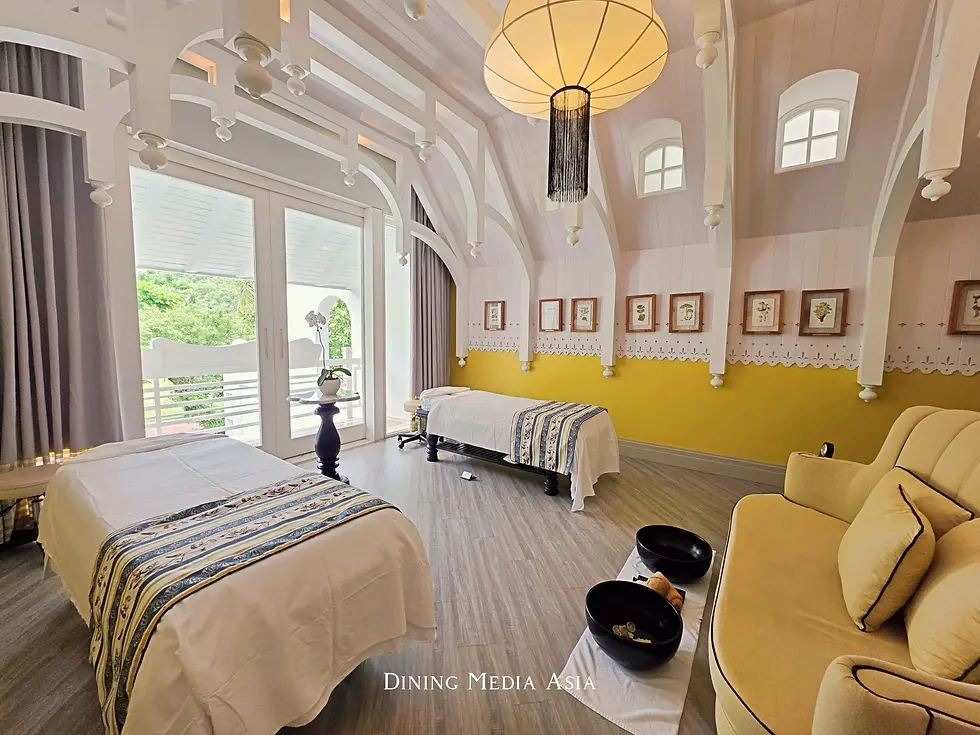
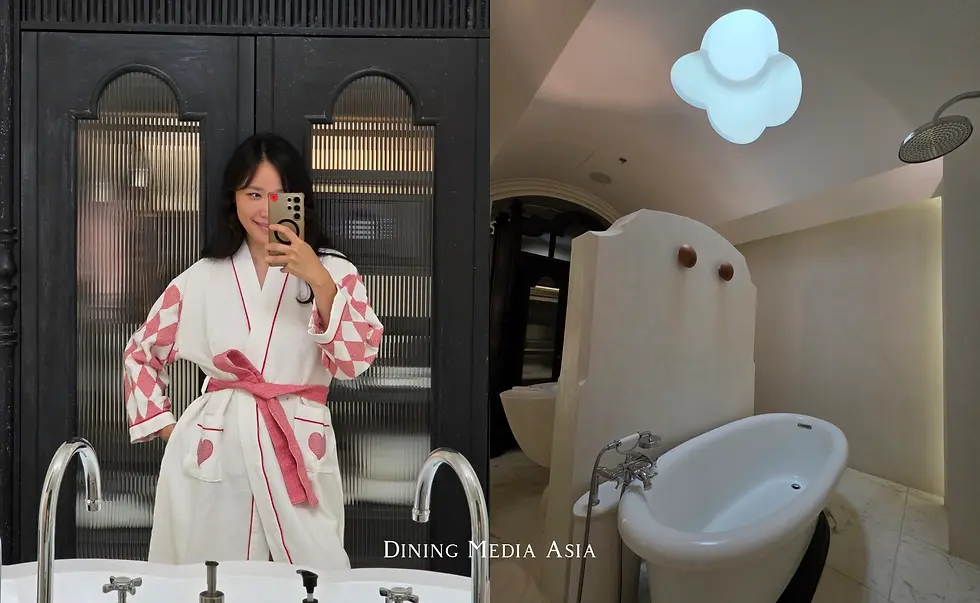
Chanterelle – Spa by JW is conceived around a fictional academic department devoted to the study of nature and fungi. Its curving forms, displays of mushroom specimens, botanical-style fungi illustrations and staff uniforms reminiscent of Alice’s dress immediately evoke the fantastical world of Alice in Wonderland. Resort spas often strip away colour and ornament in an attempt to create a sense of tranquillity removed from everyday life; here, Bensley takes almost the opposite approach, and boldly so. Like a portal into yet another imaginary world, the winding corridors and mushroom-inspired details shift your mood even before the treatment begins. And, as you can see in the photographs, even the spa robes—reminiscent of Alice’s playing-card soldiers—were irresistibly charming.
Where It Stands Among Phu Quoc’s Luxury Resorts
It is remarkable to think that it was already a decade ago. JW Marriott Phu Quoc opened in 2016, at a time when Phu Quoc was already emerging as one of Vietnam’s leading resort destinations but had yet to establish the international luxury profile it enjoys today. The hotel is often regarded as a game changer in the island’s evolution. In the years that followed, major resorts including InterContinental, Regent and New World arrived in the surrounding area, while southern Phu Quoc underwent rapid development with the addition of a cable car, theme parks and large-scale master-planned tourism infrastructure. Together, these developments have helped transform the region into the resort destination it is today. And the story continues: Park Hyatt is currently expected to make its Phu Quoc debut in 2028.

Of course, this is hardly the only luxury resort in Phu Quoc, but it possesses an identity that is remarkably difficult to replicate. There is something particularly valuable about being able to recognise a place from a single photograph. As the number of luxury hotel brands around the world continues to grow and standards of design become increasingly sophisticated, a curious paradox has emerged: many luxury resorts have also begun to look more and more alike. Expansive infinity pools, neutral-toned guestrooms, bathrooms clad in natural stone and restaurants facing the beach may all be beautiful, but they do not necessarily leave behind a memory distinctive enough to tell one destination from another. The pastel buildings of Lamarck University, its curious specimens, the pink mansion and the Department of Chemistry Bar, by contrast, are delightfully eccentric elements that could belong nowhere else. Perhaps that is why, since opening, the resort has garnered so many accolades across the worlds of design and travel.
Perfection, when we travel, can sometimes be surprisingly easy to forget. An impeccably arranged room, a swimming pool kept at precisely the right temperature, and a flawless breakfast may leave us thoroughly satisfied, but they do not necessarily leave us with a story—or even a lasting memory. Places that are a little exaggerated, a little strange, and occasionally even challenging to one’s personal taste, on the other hand, have a way of remaining vividly alive in a traveller’s memory long after the journey is over.

Also, Getting to Phu Quoc has also become noticeably easier. In April 2026, Sun PhuQuoc Airways launched its new direct route between Incheon and Phu Quoc, making the island feel considerably closer to Seoul. Being able to board a flight in Korea and arrive directly on the island without a connection makes a meaningful difference, particularly when planning a short resort escape where the journey should feel as effortless as the stay itself.
Just a few hours after leaving Seoul, you find yourself surrounded by an entirely different landscape and rhythm. From the moment you arrive, the pace begins to slow, as though the experience of JW Marriott Phu Quoc Emerald Bay has already begun. A great resort holiday always feels more complete when getting there is just as seamless, and this new direct connection makes Phu Quoc an even easier and more compelling escape from Seoul.

So, Hotels Like This Really Do Exist
The thought that returned to me most often during my stay was one of admiration for Bill Bensley—perhaps even awe. Who else would go this far? To write the history of a university that never existed; invent its departments, professors and students; create the books, specimens and trophies they might have left behind; and then build an entire campus by the sea around that imagined past. It is a choice that makes little sense if judged solely by the conventional efficiencies of hotel development. Perhaps a fiction, when pursued with this much sincerity, can become strangely moving in its own right.
Many hotels today speak of “storytelling,” but more often than not, the story ends with a paragraph on the website or a small booklet left in the guestroom. Here, the story becomes the shape of a building, the colour of a chair, the uniform worn by a member of staff and the name of a cocktail bar. What a wonderful feeling it is to step inside a book, or perhaps into another time altogether. Spending several days immersed in such a complete fiction—this particular form of escapism—was genuinely exhilarating. There is a certain pleasure in choosing, willingly, to be deceived; in surrendering to imagination and creating memories within a world that never existed. Right through to the final graduation ceremony, it was a fascinating journey.
댓글