The No. 1 Destination in the Land of Dragons: TA’AKTANA, a Luxury Collection Resort & Spa, Labuan Bajo
TA’AKTANA, a Luxury Collection Resort & Spa, Labuan Bajo. I recently had the chance to experience this newly opened resort firsthand—already sweeping awards in Labuan Bajo, one of Southeast Asia’s hottest destinations right now.

With the hope that, just as it was for me, this might become one of the greatest journeys of your life, I have taken particular care in writing this story.
Labuan Bajo. The name may be familiar to avid divers, but for most ordinary(?) travellers, it remains a relatively unknown destination. I myself had travelled to Bali nearly twenty times over the years, yet somehow I had never seriously considered Labuan Bajo, just an hour’s flight away. When planning this family holiday, I initially wanted to leave it out altogether. Bali was already a wonderful enough destination in itself, and I saw little reason to go through the trouble of boarding yet another flight. But after hearing from so many people that this was somewhere I simply had to visit, I eventually gave in. That decision ended up giving me memories I will carry with me for the rest of my life.
Labuan Bajo is a small port town at the westernmost tip of Flores Island in Indonesia. Rather than being a place overflowing with attractions in its own right, it felt more like a gateway into the extraordinary natural world of Indonesia. This is where journeys begin: boarding a boat in the early morning to climb the ridges of Padar Island; sailing for a little over an hour to Rinca or Komodo Island in search of Komodo dragons; passing Pink Beach and Manta Point before eventually returning to the mainland. Even the name Labuan Bajo speaks to this relationship with the sea: “labuan” means harbour, while “Bajo” derives from the Bajo people who have long lived along the coasts of this region. From the very beginning, the identity of the town has been inseparable from the sea and the act of setting sail.
It is such a small town that one could almost describe it simply as a port where travellers leave their luggage at a reasonably comfortable hotel, travel light, and head out to sea. For that reason, hotels here have traditionally only needed to be good enough: somewhere to spend the night before boarding a boat, or somewhere to shower and rest after returning from the islands. After all, the most dramatic moments of the journey have always taken place elsewhere—among coral forests beneath the surface of the sea, or beyond the horizon beneath a sunset turning the sky crimson.
TA’AKTANA, a Luxury Collection Resort & Spa, Labuan Bajo, however, made me realise that Labuan Bajo—or, more precisely, this resort itself—can be a complete destination in its own right, while at the same time serving as one of the most beautiful bases from which to explore the waters of Flores. Room rates may feel relatively reasonable compared with destinations such as Japan, but they still sit at the very top end of the market in Southeast Asia—approximately USD 1500 to 3000 per night on average, depending on room type. Even taking that into consideration, I found the experience immensely satisfying. Beautiful, private, and truly special.

The natural beauty of this place is extraordinary. And so, each morning, after a cup of coffee, I would put on my swimsuit, apply a generous layer of sunscreen, and dive straight into the water to snorkel. Jumping into the sea from the resort’s own deck, I found a world of coral and fish waiting just beneath the surface. Or, even better, you can simply step aboard a private yacht and set sail directly from the resort. A day can be spent exploring the Flores Sea—swimming alongside sharks, climbing the dramatic ridges of Padar Island, encountering Komodo dragons on Rinca Island, and gliding above coral reefs alongside manta rays.
And when you return at the end of the journey, the hours spent at sea flow naturally into an evening at the resort. The silhouettes of the islands you have been looking at throughout the day reappear in the language of the guestrooms and restaurants, in the lighting and architecture. Morning departures and evening returns, adventure and repose, destination and resort—all are organically connected, coming together as one seamless “experience.” It was a truly special way to travel.

Koreans will immediately understand what I mean by this: sometimes, when we stay at a truly exceptional resort, it can feel as though the best way to “get our money’s worth” is to pause exploring the local area for a while, make the most of every facility within the resort, and simply allow ourselves to rest completely. That is why many of us plan our holidays by spending, say, three nights at a more modest hotel while intensely exploring everything beyond its doors, before retreating to a luxury resort for the final two nights to do little more than relax.
But TA’AKTANA is not a place designed solely for the resort experience. Rather, it is a hotel that curates the very act of travelling through this region into one complete, cohesive experience. The magical Flores archipelago and its sea, the raw beauty of nature, the sunsets, and the comfort of the resort are woven together like a finely knotted net—one that ultimately catches something far greater: a lasting memory.

TA’AKTANA, a Name Meaning ‘Green Land’
The name TA’AKTANA means “green land” in the Manggarai language of Flores. Its most direct inspiration comes from Lingko, the traditional agricultural landscape of the Manggarai region. These distinctive fields are divided outward from a single central point, creating a pattern reminiscent of a spider’s web or a vast circular pie. This radial structure reappears throughout the resort in various elements of its design language, and for anyone like me who has a deep interest in hotel design, there is plenty of pleasure to be found in discovering these details throughout the property.

The curves of the architecture, the roofs shaped almost like Hershey’s Kisses, and the use of natural materials all take their cues from the traditional houses and craftsmanship of Flores. The overwater villas, meanwhile, draw inspiration from a different lineage altogether: the maritime way of life of the Bajo people. Together, these elements subtly convey how land and sea form the two defining axes of Labuan Bajo. Yet despite borrowing from numerous traditional references, the resort never feels like a folk museum. Handcrafted objects, along with thoughtful details such as the woven bags placed in every guestroom for use throughout the stay, allow traditional sensibilities to be experienced through a contemporary and sophisticated lens.
In any case, this really is a very new resort. TA’AKTANA opened in 2024. It was Marriott International’s first hotel in Labuan Bajo and the second The Luxury Collection resort to open in Indonesia. Set between forested hills and the Flores Sea, the property encompasses overwater villas extending out across the sea, as well as suites and pool villas on land. From the moment it opened, TA’AKTANA became a symbol of Labuan Bajo’s transformation from simply a “gateway to Komodo National Park” into a luxury destination where travellers might choose to stay and linger. Personally, I find that the experience can vary somewhat from one Luxury Collection property to another, but here, I felt the level of service ranked among the very best within the brand. (I will come back to this later, particularly when discussing the butler service.)
The Resort by Day, and by Night
With the sea opening toward the setting sun, the resort’s landscape becomes even more dramatic as evening approaches. During the day, the intense tropical sunlight brings the textures of wood and stone into sharp relief, while almost dissolving the boundary between the architecture and the sea. Standing in the lobby, your gaze is naturally drawn toward the water, while the swimming pool, terraces, and pathways all seem to lead toward the blue horizon.


But as the sun begins to sink, the character of the space changes. As the light over the Flores Sea shifts from pink to violet and finally fades into darkness, the architecture gradually begins to reveal its presence. The resort has received considerable praise within the design world for its exceptionally beautiful lighting scheme, and it is after sunset that its full effect becomes apparent. One by one, subtle lights come alive along the lines of the roofs and columns, the stairways and walkways extending over the sea. Curves that remain almost hidden in natural daylight are redrawn in light at night. With linear indirect lighting used extensively throughout the property, the entire resort takes on a beauty that is at once soft, understated, and remarkably refined.
Studio Nimmersatt, responsible for the lighting design, explains that it developed a multilayered lighting system inspired by the Lingko fields of Manggarai. Along the pathways leading to the overwater villas, custom-designed lighting gently guides guests through the darkness, while indirect illumination tracing the columns and rooflines creates the impression that the architecture is floating above the water and the night itself. The project has also received international lighting design awards for the way it translates the patterns of a traditional landscape into a flowing language of light.


Time Spent in a One-Bedroom Villa
Two adults, two children. Our family stayed in a One-Bedroom Villa. In truth, what makes a great villa is not simply the formal checklist of generous space and a private pool; it needs to possess a certain sense of privacy and intimacy, something that makes it feel like “our own home” within the hotel. The villa here understood that perfectly. The space itself is more than generous, but what impressed me just as much was how thoughtfully the flow had been designed. The first things to catch the eye are the expansive, horizontally proportioned living room with its beautiful panoramic view, along with a guest bathroom, a butler/nanny pantry, and an outdoor deck extending onto the terrace and private pool.
Beyond this lies the more private part of the villa. Passing through a door, you enter a spacious dressing room, followed by a large bedroom and terrace, and then a bathroom almost as expansive as the bedroom itself. There is ample room for everything: a bathtub, a table, twin vanities, and a separate toilet. Each area is clearly defined, yet the spaces flow together as though in a single breath.
The interiors feel decidedly contemporary. While ethnic elements are incorporated throughout, convenience has clearly been given overriding consideration when it comes to practical details such as switches and IoT controls, making the villa exceptionally comfortable and effortless to live in.

Aesthetically, too, the villa is beautiful. The form of the Lingko that runs as a recurring motif throughout the resort, Manggarai weaving traditions, and patterns and colours drawn from the islands and marine ecosystems of Flores all delight the eye in different ways. Of course, guests do not need to know every one of these references as I did in order to appreciate the space. For me, too, comfort ultimately came first. Spending time with my family in the living room, stepping out onto the terrace to watch the colours of the sky slowly change… Sometimes an exceptionally beautiful space can feel almost like a showroom, somewhere you pause briefly to take photographs rather than truly live in. Here, however, our bodies quickly became accustomed to the rhythm and flow of the villa, and before long it began to feel like our own home.
When Does Service Become Luxury?
First of all, applause. The service was excellent. Thoughtfulness and privacy were balanced beautifully. (To be honest, this is something that continually surprises me at Indonesia’s finest resorts…) Butler service was included with our villa, and through WhatsApp, I could access it effortlessly from my own phone, anytime and anywhere. If we needed a buggy, one was sent for us. If I said I wanted coffee, they brought it directly to the villa every day.
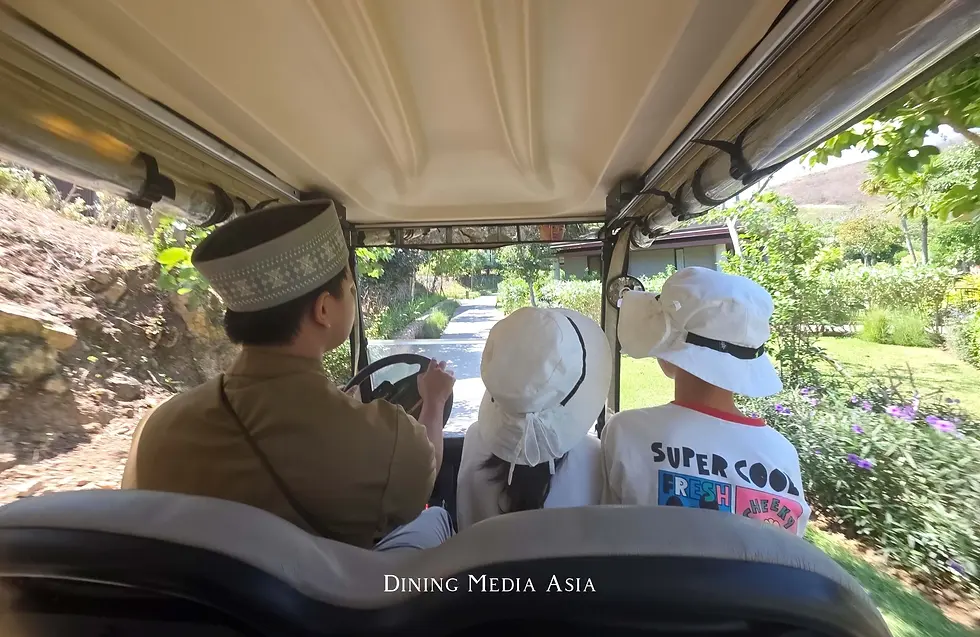
A good butler does not need to attend to a guest’s every move. Nor do I think the familiar description of “having everything prepared before you even have to ask” quite captures what great service is about. The real essence lies in knowing when to care for a guest from close at hand, and when to step back so that they can feel entirely immersed in their own private time. What made the service at TA’AKTANA so impressive was precisely this ability to read the rhythm of our journey without ever making itself overly visible.
When travelling as a family, there are inevitably many moments when things do not go according to plan. Children move at a different pace from adults, mealtimes shift, and after returning from a day out on the water, everyone may be far more tired than expected. The true level of luxury service reveals itself in how gracefully and flexibly it responds to these changes.
Here, there was rarely any need to explain our requests repeatedly, whether large or small. At one point, access to the national park was restricted because the waves were stronger than expected, disrupting our planned island-hopping itinerary. Our butler quickly suggested an alternative route for exploring the islands. It could easily have been a disappointing situation, yet there was a reassuring sense that he understood our family’s schedule and preferences, and everything we needed was seamlessly coordinated within the resort. Nor did I ever feel the burden of receiving some enormous favour each time I asked for something. Thoughtfulness never arrived as a grand gesture or a special event; instead, it was quietly woven into the everyday rhythm of our stay.
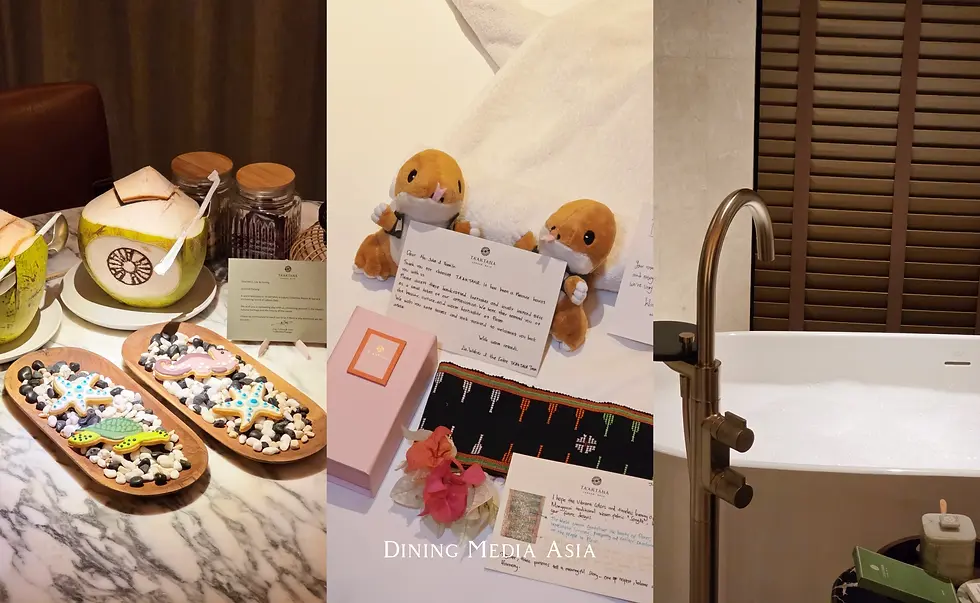
One moment in particular stayed with me. We had spent the day island-hopping aboard a private yacht, from noon until well past seven in the evening, and despite the heat, after so many hours in and out of the water, I was exhausted. All I could think on the way back was, “When I get to the villa, I really need to take a warm bath.” When we returned, cookies shaped like turtles and manta rays were waiting on the living-room table, while on the bed sat a stuffed Komodo dragon, recalling the one we had seen on Komodo Island that very day. Then I walked into the bathroom, thinking I would finally run myself a warm bath. As though someone had read my mind, the bathtub was already filled with warm water and clouds of white bubbles. Even the temperature was exactly right. There was no need to wait for a single moment, as though some invisible, magical hand had quietly prepared everything for my return.
I have been surprised by exceptional hospitality many times over the years. I remember arriving at Four Seasons Hotel Firenze for the very first time in my life and, the moment I reached the gate, hearing a member of staff say, “Julia, welcome.” I remember the extraordinary service at Rosewood Hong Kong, where every member of staff seemed to know my name and face. And I have stayed at many luxury resorts where a special gift and handwritten note would be waiting each night when I returned to my room. Yet perhaps what matters most is something quieter: reducing the countless small decisions and inconveniences that travellers would otherwise have to deal with themselves, while still leaving them with the feeling that their time remains entirely their own. The hospitality at TA’AKTANA came remarkably close to achieving that difficult balance.
Straight from the Hotel to the Sea
Ultimately, the greatest reason to visit Labuan Bajo is the Flores Sea and Komodo National Park. Inscribed as a UNESCO World Heritage Site in 1991, Komodo National Park encompasses Komodo, Rinca and Padar islands, along with the surrounding waters, and is renowned not only for the Komodo dragon but also for its extraordinarily rich marine ecosystem and dramatic volcanic island landscapes. Naturally, heading out to sea is the highlight of any journey here.
Many travellers arrange boat tours through agencies in town or depart from external jetties. The usual routine is to leave the hotel early in the morning, travel by car to the harbour, join other groups, board a boat, and spend the day exploring. There is, of course, nothing wrong with this experience. In fact, the small boats, the energy of the harbour, and the atmosphere of setting out alongside fellow travellers are all an important part of travelling through Labuan Bajo.

TA’AKTANA, however, creates an experience that feels far more special and private. The resort has its own direct connection to the sea, allowing guests to step aboard a boat straight from its private jetty. There is no waiting in the lobby for a tour operator’s car, no journey into the crowded harbour in town. Instead, you can enjoy a leisurely breakfast, board your boat directly from the resort, spend the day exploring the islands, and return to exactly the same place at the end of it all.
More importantly, the resort’s standards of service, aesthetics, and comfort continued even once we were out at sea. A member of the hotel’s dedicated watersports team accompanied us throughout the day, constantly enriching the journey with stories and insights—pointing out “the best place to spot sharks,” explaining the lives and behaviour of Komodo dragons, and helping to make our day feel complete. With our children, he exchanged Indonesian and Korean words, joked and laughed, and gradually became a private teacher, guide, friend, and guardian all at once, gently and effortlessly leading our family into the extraordinary world of the Flores Islands.





A Table Filled with the Flavours of the Islands
One of the things that left a deeper impression than I had expected at TA’AKTANA was the food. Dining is particularly important at a destination resort. Guests spend a considerable amount of time within the property over the course of several days, and few things are more frustrating than being confined to a resort where the food simply is not good. If there is not enough variety in both the menus and the atmosphere, even the most beautiful resort can quickly begin to feel monotonous.
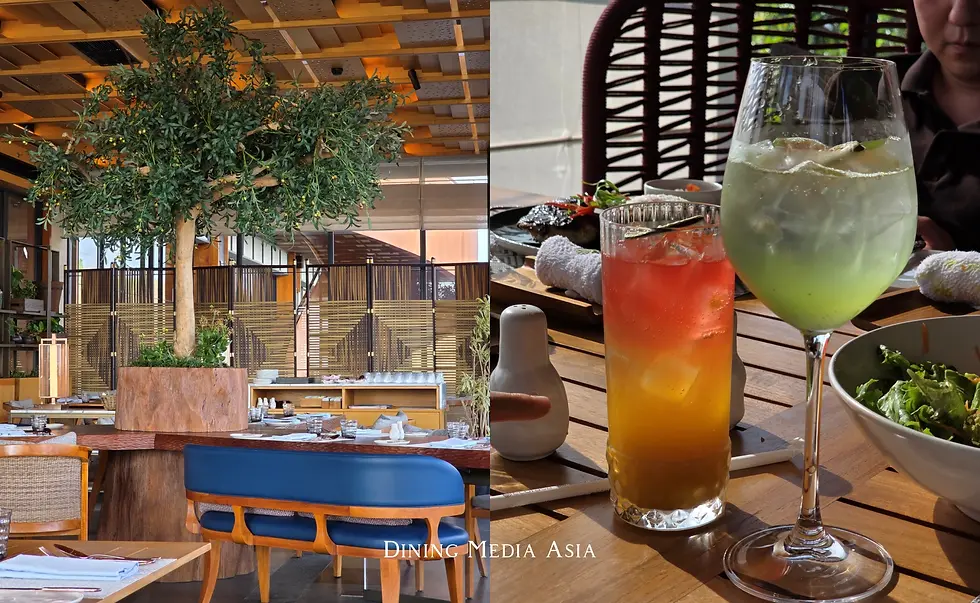

TA’AKTANA has five food and beverage venues, including three restaurants, a bar, and a lobby lounge. The first is Leros, the resort’s main all-day dining restaurant, open from breakfast through dinner and offering an international menu alongside a diverse selection of dishes from across the Indonesian archipelago. At breakfast, it provides all the familiar comforts of a classic hotel breakfast while expressing a strong sense of place through Indonesian rice and noodle dishes, sambal, tropical fruits, and spices.
The beef noodles and moringa soup, in particular, were genuinely delicious and quickly became our children’s absolute favourites. Even familiar dishes such as the Wagyu cheeseburger and spaghetti were very well executed. The quality was so satisfying that, had Leros been a restaurant in the middle of a bustling city, I would happily have returned again and again.


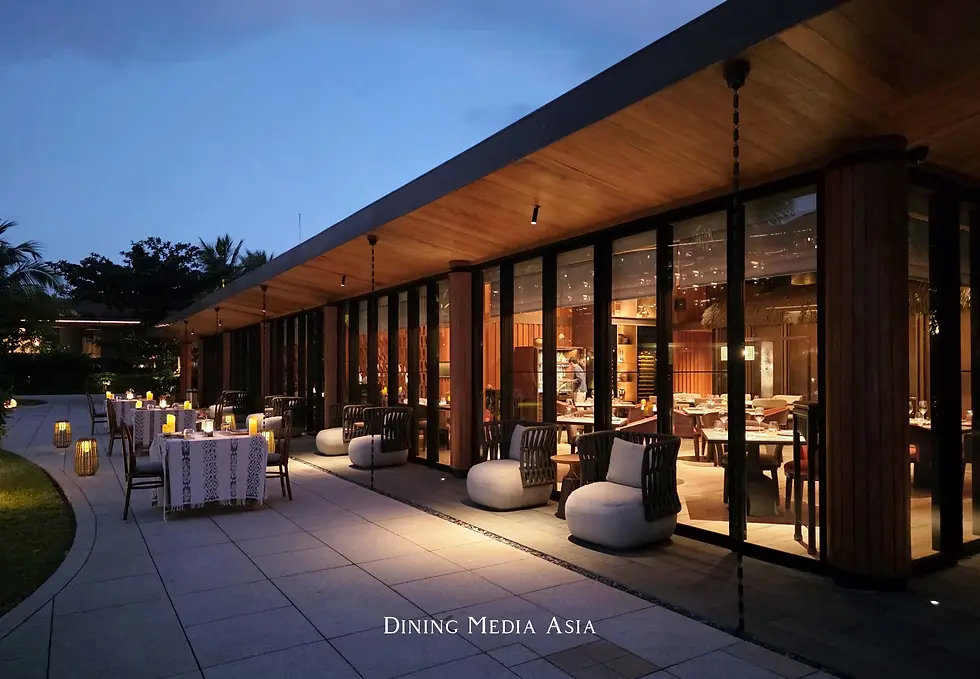
Umasa was another highlight. The restaurant takes the distinct cooking traditions and ingredients found across Indonesia’s vast archipelago and reinterprets them through a contemporary lens. The food was far more than simply “good for a hotel.” Returning for dinner after a day spent exploring the islands felt almost like revisiting the journey we had just experienced. The landscapes we had seen from the sea, the wind we had felt aboard the boat, the spices of Flores and the aroma of charcoal all seemed to reconnect on the plate.
Much like the resort’s architecture and interiors, the food never presented local culture in an overly folkloric way. It respected the origins and traditions behind each dish, while translating them into a language that felt refined, contemporary, and immediately accessible to the traveller.
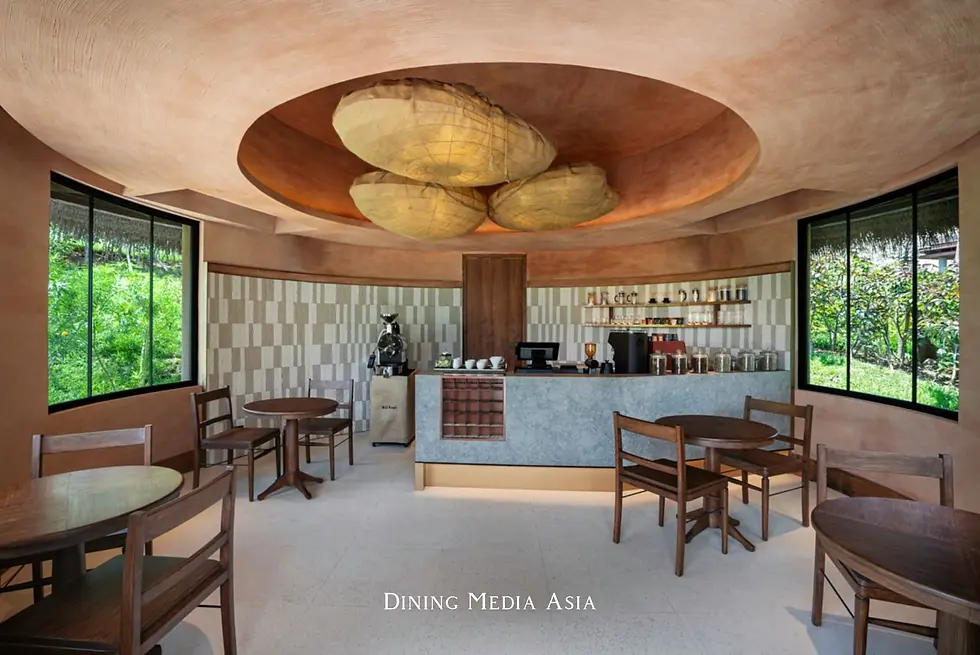

Another fascinating detail is that the resort has its own coffee roastery. Every morning, beans used throughout the property are roasted here, and guests can watch the process before tasting the rested beans themselves, either as a hand brew or in an espresso-based drink. Of course, the same beans are served across the resort’s restaurants, but there was something particularly special about lingering in the roastery, surrounded by the aroma of freshly roasted coffee, with a glass of iced hand-drip coffee in hand. I also loved being able to compare single-origin beans from different regions across Indonesia, listening to the stories behind each one as I tasted them.
A Sense of Completeness, Discovered Through Family Travel
It was a deeply happy time. In this place, where a sense of awe before nature coexists with the ultimate luxuries created by human hands, we spent days that none of us will forget. Sometimes we simply stretched out on a sunbed and enjoyed the warmth of the sun. On another morning, we woke at five to join a sunrise yoga session together. We dived straight into the sea from the resort’s deck and, for the first time in my life, I even tried a water scooter.
Swimming with sharks, watching fruit bats turn the sky almost black as they flew out in search of food, encountering Komodo dragons in the wild—every one of these experiences was a first for us, and each left an indelible impression. For our family, this was a destination resort in the truest and most complete sense of the word.

The easiest way to introduce a newly opened luxury resort is to call it a “hidden paradise.” But Labuan Bajo is no longer quite so hidden. Its airport and harbour are expanding, international hotel brands and new resorts are arriving in the surrounding area, and the number of travellers making their way to Komodo National Park continues to grow. As Condé Nast Traveller’s selection of Labuan Bajo as one of the Asian destinations to watch in 2026 suggests, the secret is already beginning to reach the wider world. Even so, there is no doubt that beyond Bali, Labuan Bajo remains a relatively new and compelling alternative well worth turning your attention to.

The hotel’s main building sits high on a hill, and one evening, I stood there watching countless boats floating across a sea shimmering beneath a crimson sunset. The same boats that had spent the day carrying travellers between the islands were returning to the harbour and the bay, their lights beginning to glow one by one. In the distance, the hills and small islands dissolved into a single dark line against the night, while warm light flowed along the curves and pathways of TA’AKTANA.
What, after all, is luxury? As human beings, is there anything more meaningful than standing before a landscape we know we will remember for the rest of our lives; looking out over the same sea with our family; setting off together for some distant island, and then returning to a place that feels safe and warm? The rooms at TA’AKTANA are beautiful, the villas are spacious, the food is excellent, and the service ranks among the most thoughtful I have experienced at any hotel. But more important than the sum of all those elements was the kind of time this hotel made possible for us.

We could be comfortable without giving up adventure, and even while travelling together as a family, each of us could still enjoy our own moments of rest. We could spend the entire day out discovering the world, or remain in the villa and do absolutely nothing. Perhaps this is the most complete expression of what a destination resort can be.
댓글