Four Centuries of Craftsmanship, Reimagined Through Contemporary Aesthetics: Hyatt Centric Kanazawa
Hyatt Centric Kanazawa offers a contemporary interpretation of the city's distinctive aesthetic, where art galleries, artisan workshops, beautiful gardens, and historic streets come together.

What is Japan's most beautiful city? From Kyoto, the ancient capital with a thousand years of history, to the vibrant metropolis of Tokyo and the serene landscapes and temples of Nara, every city possesses its own distinctive character. Yet for travelers seeking a deeper understanding of Japan's traditional beauty, Kanazawa deserves particular attention. Here, centuries-old cultural heritage and contemporary artistic sensibilities coexist effortlessly. It is a remarkable cultural destination where the craftsmanship and artistic traditions cultivated over hundreds of years continue to evolve today. One of the things I find most fascinating about traveling is discovering the unique sense of beauty that a city has developed over time. Kanazawa had long been a destination I wanted to explore. The fact that Korean Air operates daily direct flights from Incheon to Komatsu Airport makes the journey particularly convenient.
Located in Ishikawa Prefecture along the East Sea coast of central Honshu, Kanazawa has a history closely associated with the Maeda clan, which governed the Kaga Domain during the Edo period. Known as Kaga Hyakumangoku (加賀百万石), a name reflecting the domain's extraordinary wealth, its feudal lords invested extensively not only in military strength but also in culture and the arts. There is something about Kanazawa that still evokes the refined atmosphere of a wealthy aristocratic household. The Maeda family invited distinguished artisans from Kyoto and Edo, fostering an environment in which metalwork, ceramics, dyeing, lacquerware, and gold-leaf craftsmanship could flourish. These traditions ultimately shaped the distinctive cultural identity that Kanazawa retains today.
Walking through the city reveals this remarkable heritage at every turn. In Higashi Chaya District, historic teahouses and craft galleries line streets of traditional wooden buildings with delicate lattice façades. The Nagamachi Samurai District preserves the atmosphere of the samurai era. Kenrokuen, considered one of Japan's three great gardens, offers an exquisite expression of Japanese garden artistry, while the 21st Century Museum of Contemporary Art, Kanazawa, designed by SANAA, introduces visitors to contemporary architecture and experimental art. In 2020, the National Crafts Museum relocated from Tokyo, establishing another important cultural institution dedicated to understanding Japanese craftsmanship. Kanazawa has also been a member of the UNESCO Creative Cities Network in the field of Crafts and Folk Art since 2009.
Gold leaf is another essential part of Kanazawa's identity. Approximately 99 percent of Japan's gold leaf is produced here. Creating a single sheet measuring approximately 0.1 micrometers in thickness requires metal, specially prepared paper, and countless repetitions of an extraordinarily delicate process. So fragile that even the slightest movement of a fingertip can damage it, gold leaf has become a symbol of the craftsmanship preserved in this city over generations. The technique is incorporated into ceramics, lacquerware, architectural decoration, and numerous other artistic forms, creating a visual language uniquely associated with Kanazawa.
Despite its rich history and traditions, Kanazawa is far from a city confined to the past. Contemporary art museums, studios run by emerging artists, and craft brands that reinterpret traditional techniques can be found throughout its neighborhoods. The city's aesthetic philosophy lies in preserving and passing down historical traditions while finding beautiful new ways to integrate their value into contemporary life.
During this trip, I naturally wanted to visit the city's celebrated historical landmarks. At the same time, I hoped to experience Kanazawa's artistic sensibility within the very place where I would be staying. Traditional ryokan and boutique hotels converted from historic Japanese residences certainly have their charms, but on this occasion, I was looking for somewhere that combined the comforts of an international hotel brand with an authentic immersion in Kanazawa's culture.
Hyatt Centric Kanazawa, which opened in August 2020, proved to be an excellent choice. Situated immediately beside the west exit of Kanazawa Station, the hotel offers exceptional convenience, with Shinkansen services and bus connections accessible within a three-minute walk. While providing all the modern comforts expected of an international hotel, the property incorporates Kanazawa's traditional crafts and works by local artists throughout its interiors.
With 253 guest rooms and suites, the hotel features more than 100 artworks, inviting guests to explore the property and discover the stories behind them. What interested me most was the thoughtful way these works were integrated into the guest experience, allowing visitors to engage naturally with local culture throughout their stay. Time spent at the hotel becomes an opportunity to develop a deeper understanding of the city's cultural identity.
Encountering the Art of Kanazawa from the Moment You Arrive
Hyatt Centric Kanazawa draws artistic inspiration not only from finished craft objects but also from the processes of making them, the tools used by artisans, and the city's history and everyday cultural traditions. The spaces reinterpret traditional craftsmanship through a contemporary lens without losing sight of its original meaning.
What impressed me most was that the local craftsmanship extended far beyond superficial decoration. Instead, it served as an authentic medium for communicating the stories of the city. Exploring the thoughtfully curated collection, I found myself learning about individual artists and artisans, their creative processes, and the history of Kanazawa itself.

The first artwork encountered upon arrival makes an immediate visual impression. Sculptor Atsushi Ozawa's 野鍛治の門冠 is a striking golden sculpture inspired by the form of a pine tree. From a distance, it resembles an ancient pine growing in a traditional Japanese garden. On closer inspection, however, its structure reveals an unexpected origin: agricultural implements and iron tools once used in Kanazawa have been collected, hammered, and reconstructed to form the sculpture.
The gold-leaf finishing was carried out by Hakuichi (箔一), a local company specializing in gold-leaf craftsmanship, transforming these ordinary fragments of aged iron into a luminous golden artwork. The sculpture embodies the philosophy of Kanazawa's artisans, who find new value and beauty in materials that have already served their original purpose.

Behind it, an expansive painting in deep shades of blue creates another compelling visual moment. Blue Rhythm, by Yoshinobu Omori, takes inspiration from the Sai and Asano rivers that flow through Kanazawa, as well as the waterways that traverse the city. Across a canvas approximately three meters high and 4.5 meters wide, the artist expresses the movement of water through sweeping, fluid lines.
The contrast between the freely flowing blue forms and the stillness of the golden pine evokes the atmosphere of a contemporary Japanese folding screen. Personally, I found the harmony between these two very different works particularly beautiful. Traditional gold-leaf craftsmanship and contemporary painting speak in entirely different artistic languages, yet together they connect Kanazawa's history and natural environment within a single visual composition.
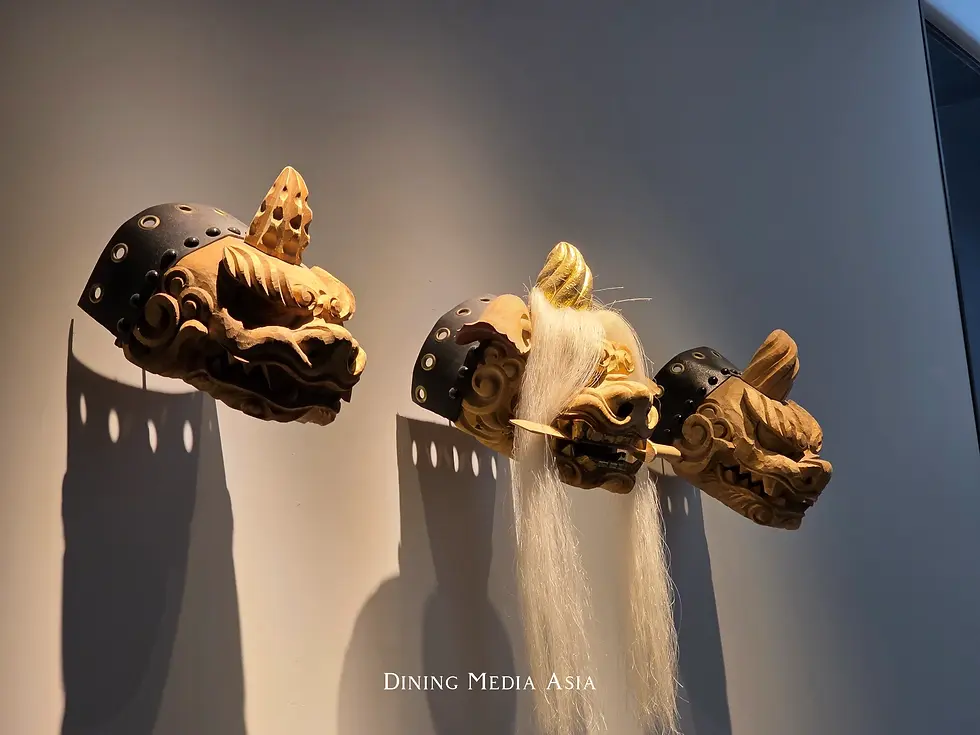
Venturing farther into the hotel, visitors encounter another work inspired by the lion heads used in Kaga Shishimai (加賀獅子舞), the traditional lion dance of the Kaga region, including Kanazawa. An important element of this inherited folk performance tradition is the intricately carved lion head.
The hotel incorporates the concept of small trial carvings traditionally created to examine the form of a lion head before producing the finished piece. It is a fascinating reminder that artistic beauty can be found not only in completed craft objects but also in the preliminary stages of an artisan's creative process.
A Small Museum of Gold Leaf, Dyeing, and Metalwork
The check-in lobby on the third floor offers another visually engaging experience. Against a design backdrop inspired by the wooden lattice patterns and traditional colors of Kanazawa's historic teahouse districts, artworks by various artists are arranged naturally throughout the space.
I enjoy visiting museums and galleries, but I am equally drawn to the unexpected pleasure of encountering exceptional art in ordinary surroundings. Here, artworks are not confined to glass display cases as objects to be observed from a distance. Instead, they become part of everyday moments, whether checking in or simply taking a short break. I appreciated that sense of effortless familiarity.

One particularly captivating installation is Pliant Metal 2020 / Hyatt Centric Kanazawa Ver. by gold-leaf designer Ai Takaoka. The work transforms gold leaf, a material traditionally associated with flat decorative surfaces, into a contemporary installation characterized by movement and three-dimensional form. Composed of 36 panels made from stainless-steel mesh coated in gold leaf, the installation features delicate golden surfaces that respond subtly to the surrounding air currents.
Traditionally, gold leaf is applied to the surfaces of Buddhist statues, folding screens, and lacquerware, where it is appreciated as part of a completed decorative object. In Takaoka's installation, however, the material appears almost alive, responding to changes in light and air. The subtle shimmer of the metal and the thin golden surfaces shift with the viewer's perspective, creating a presence that is simultaneously delicate and powerful. It is a compelling demonstration of how an age-old material can generate entirely new forms of beauty, expanding our understanding of what traditional craftsmanship can become.
Another remarkable work is 象嵌朧銀花器「窓明」 by Mamoru Nakagawa, a master metalworker recognized as a Living National Treasure of Japan for his expertise in chōkin, the traditional art of metal engraving. Born in Kanazawa in 1947, Nakagawa is a leading practitioner of Kaga inlay and was designated a Living National Treasure in 2004. His works are held in the collections of internationally renowned institutions, including the Metropolitan Museum of Art in New York and the British Museum in London.
Kaga zōgan (加賀象嵌), the metal-inlay technique he has inherited and developed, involves precisely carving into a metal surface and inserting different metals to create patterns and subtle variations in color. During the Edo period, the technique was used to decorate samurai swords and horse saddles before gradually evolving into an independent form of artistic expression.
Nakagawa is particularly known for using the contrasting tones and reflective qualities of gold, silver, copper, and other metals to create painterly depth and delicate transitions of color. Silver-gray and deep bluish-black tones, together with intricate lines and patterns extending across the metal surface, encapsulate the extraordinary precision associated with Japanese craftsmanship. What I found particularly beautiful was the restrained elegance created by the natural colors of the metals themselves. For an art enthusiast, simply encountering a work by a master whose creations are collected by the world's leading museums, and experiencing it so naturally within a hotel lobby, is an exceptional pleasure.

The City's History Woven into an Old Kimono
Returning to the first floor, another intriguing artwork awaits: Ruri Mio's 加賀国金沢之絵図 銹雲唐草. At first glance, it resembles an antique kimono suspended from a traditional garment stand. Moving closer, however, reveals an old map of Kanazawa extending across the fabric.
Cloud and vine patterns created using rust and plant-based dyes overlap the historical map, while the plum-blossom crest of the Maeda clan, which once ruled the Kaga Domain, appears on the left shoulder. Geography, regional history, and traditional dyeing culture are layered together within a single work. The reddish tones of rust, natural colors, and interwoven lines of the old map evoke an aesthetic of traces accumulated through the passage of time.

Understanding Kaga Yuzen (加賀友禅), one of Kanazawa's most celebrated traditional dyeing techniques, makes the work even more fascinating. Kaga Yuzen is based on the five traditional colors known as Kaga Gosai (加賀五彩): indigo blue, crimson red, ochre, deep green, and ancient purple. The technique is distinguished by its delicate representation of the natural world.
Artisans may depict even the tiny marks left by insects feeding on leaves, while subtle gradations of color create a sense of volume and depth. Compared with Kyoto's Kyo Yuzen, which frequently incorporates elaborate gold decoration and embroidery, Kaga Yuzen pursues a more restrained form of beauty.


This aesthetic sensibility can even be found inside the hotel's elevators. Works by artist Kozo Morita feature colorful arrangements of dots resembling enlarged samples from the color palettes used in Kaga Yuzen production. The repetition of differently sized dots initially suggests an abstract contemporary painting, yet the imagery is rooted in the processes of traditional textile dyeing. I also found it amusing that the artist incorporated Kanazawa's famously rainy climate into the composition as a playful visual element.
Throughout the hotel, there is no need to set aside special time or visit a designated exhibition space to appreciate art. Even a brief elevator journey becomes another opportunity to discover stories about the city's history and craftsmanship. I liked the fact that passing through the same space repeatedly could still reveal new details each time.
Craftsmanship: The Beauty of the Creative Process
One of the most fascinating aspects of Hyatt Centric Kanazawa's art curation is its attention to the moments before a craft object reaches its finished form. Many hotels display beautiful handcrafted objects, but it is far less common to encounter a curatorial perspective that recognizes aesthetic value in the tools and materials used during production, or even in materials that would ordinarily be discarded once their original purpose has been fulfilled.
An installation in the elevator hall incorporates recycled leather previously used during the gold-leaf-making process. The material originally came from the bodies of shamisen, traditional Japanese stringed instruments, or from old leather bags, before being repurposed for work involving the thinning of gold leaf. The hotel has given this leather yet another life as an artwork. Layers of dark and light-colored leather evoke the winter scenery of Kanazawa, where white snow settles upon the city's traditional black-tiled roofs.
On the guest room floors, the elevator halls feature artworks created from washi paper once used to filter lacquer. During the lacquer-making process, paper is employed to remove impurities and is generally discarded after use. Here, sheets of paper permeated with lacquer and subsequently dried have been gathered and transformed into new sculptural patterns. Each floor features different colors and forms, turning even the simple act of moving between one's room and the elevator into a moment of artistic appreciation.
What impressed me most about these installations was an aesthetic insight that goes beyond the environmental significance of recycling old materials. The tools and materials repeatedly handled by artisans in pursuit of a perfectly finished object carry within them countless hours of labor and accumulated human touch. They become records of craftsmanship itself, preserving the history of work that would otherwise remain invisible. By honoring not only the finished result but also the processes involved in creating it, these works offered me a deeper understanding of the spirit of Kanazawa's artisans.

KAKERA 5, an installation unveiled in August 2025 to celebrate the hotel's fifth anniversary, embodies a similar philosophy.
Created by KAKERA, a craft brand based in Ishikawa Prefecture, the work incorporates fragments of Kutani ceramics damaged during the 2024 Noto Peninsula earthquake, together with pieces of white porcelain that failed to meet production standards and would otherwise have gone unused. Ceramic fragments featuring different colors and patterns have been assembled into the shape of the number five, symbolizing the hotel's fifth anniversary. Traditional materials including gold leaf, lacquer, and washi paper are incorporated into the work, while its base is finished using Wajima lacquerware techniques.
The broken fragments reveal a beauty entirely different from that of a flawless craft object. More importantly, by transforming materials associated with a region affected by the earthquake into a new creative work, the installation becomes a symbol of local memory and recovery. I believe art becomes especially meaningful during travel when it allows us to discover the stories of people and places that exist beyond the artwork itself. Understanding those stories adds another dimension to the experience of a destination.

Art Extending into the Guest Rooms
What about the guest rooms? Even the room numbers are crafted from Kutani ceramics. Kutani-yaki (九谷焼) is one of Ishikawa Prefecture's most representative ceramic traditions, renowned for its vivid use of green, yellow, red, purple, and deep blue tones. The craft has developed a distinctive visual identity through intricate decoration and bold expressions of color. Thirteen different designs are used for the hotel's room-number plaques, each contributing a lively sense of individuality through its colors and patterns.

Inside the guest rooms, the headboards also conceal references to Kanazawa's urban landscape. Decorative panels in shades of red and blue are created from impressions of cracks in the pavement, manhole covers, and other traces found on the city's streets, transferred onto washi paper. The blue takes inspiration from the ultramarine room of Seisonkaku (成巽閣), a historic cultural property associated with the Maeda family, while the red evokes elements of the region's traditional architecture and color palette. Even the gold-leaf accents incorporate motifs inspired by the footprints of geta, traditional Japanese wooden sandals. In a sense, the very surfaces of the city that travelers will walk upon have been brought into the guest room and transformed into art.
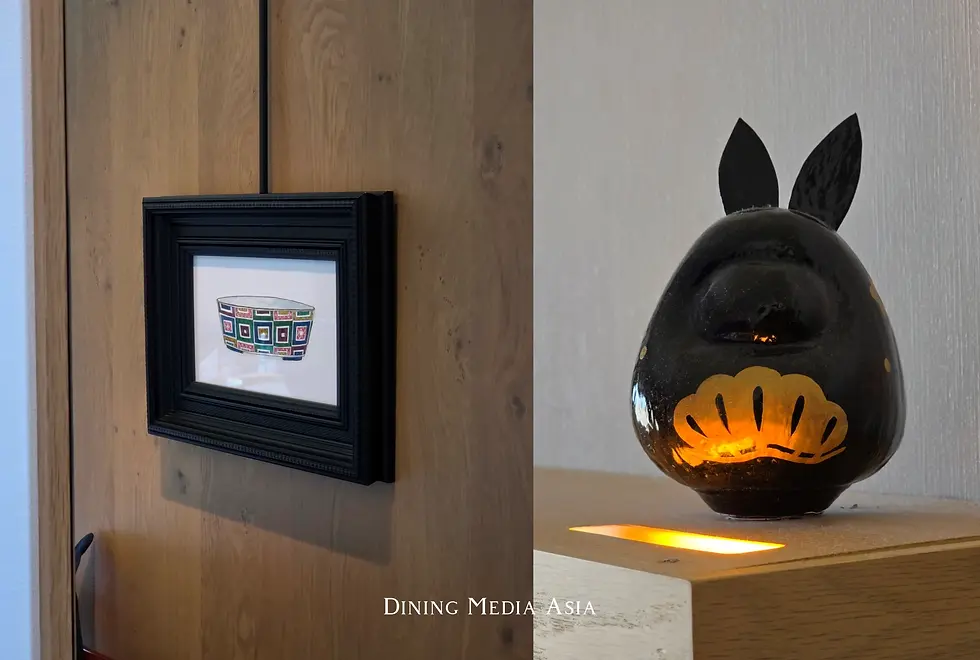
The smaller decorative objects are equally interesting. Among them is a rabbit figurine inspired by Kaga Hachiman Okiagari (加賀八幡起上り), a traditional folk craft from Ishikawa Prefecture. These auspicious roly-poly dolls are designed to right themselves when knocked over, symbolizing resilience and good fortune.
The hotel's rabbit motif also draws inspiration from Kyoka Izumi (泉鏡花), the celebrated writer born in Kanazawa. Izumi is said to have regarded rabbits as symbols of good luck and collected various rabbit ornaments. The hotel playfully incorporates this literary anecdote into both its guest rooms and public spaces.
The rooms themselves achieve a harmonious balance between artisanal beauty and contemporary convenience. What I particularly appreciated about my stay was the opportunity to experience the traditional sensibilities of the region while enjoying the familiar efficiency and comfort of an international hotel brand. For travelers who need to work or attend meetings during their trips, this practicality is especially valuable. It offers a different kind of experience from a memorable night in a traditional Japanese inn, one that feels particularly well suited to the everyday needs of the contemporary traveler.
The same balance continues at breakfast. Whenever I travel, I try to experience as much of the local food culture as possible. Yet when it comes to hotel breakfasts, I also believe that comfort, flexibility, and the freedom to choose according to one's preferences and schedule are important. Here, regional elements reflecting Kanazawa's culinary culture are naturally combined with the familiar conveniences of an international hotel. For me, the pleasure lay in being able to explore the culture of an unfamiliar city without sacrificing the small comforts of everyday life. Kanazawa is also famous for its distinctive style of curry, and I particularly enjoyed being able to start each morning with a satisfying serving of its rich, flavorful curry.

A Living Center of Craftsmanship: A Stage for an International Art Fair
The cultural significance of Hyatt Centric Kanazawa extends beyond its permanent art collection. The hotel also serves as a venue for cultural events that introduce new possibilities in traditional craftsmanship and contemporary art. KOGEI Art Fair Kanazawa, a Japanese art fair specializing in crafts, will take place at the hotel from November 27 to 29, 2026. The event will bring together 49 galleries from Japan and abroad, presenting works across a broad range of disciplines, including ceramics, lacquerware, metalwork, glass, dyeing, and textiles. Visitors will have the opportunity to encounter works by internationally established artists alongside those of emerging talents attracting new attention.
What makes the event particularly interesting is its unconventional exhibition format. Rather than taking place in a designated banquet hall, the fair will transform the hotel's second, fourth, and fifth floors into exhibition spaces. This creates an intimate environment in which travelers and artists can interact while exploring the evolving world of contemporary craftsmanship. It is also an opportunity to consider how the functional values of traditional crafts intersect with their artistic significance as works of fine art. The event demonstrates that the hotel is not simply a place where art is displayed, but also an active platform for new artistic creation and cultural exchange.

Kanazawa, a Beautiful City of Craftsmanship
The stories of craftsmanship discovered within the hotel become even richer when exploring Kanazawa itself.
Having encountered so much of the city's artistic history through the hotel's collection, I found myself paying closer attention to small details throughout its streets. There was a particular pleasure in recognizing the colors, patterns, and techniques I had seen in artworks and discovering how they continued to exist in actual workshops, traditional buildings, and everyday urban life.
One of the first places I would recommend is Higashi Chaya District. Along its historic streets, lined with dark wooden façades and delicate latticework, visitors will find craft galleries and specialist shops, as well as opportunities to experience gold-leaf craftsmanship firsthand. Rather than simply purchasing a finished object, I would encourage visitors to spend some time understanding how it is made and appreciating the artisan's work. The district is a pleasure to explore even without a particular destination in mind. And when a break is needed, there are plenty of excellent cafés to discover, including several serving remarkably good coffee.
At Kanazawa Bikazari Asano, visitors can explore Ishikawa's traditional crafts, including Kutani ceramics, Kaga Yuzen textiles, and gold-leaf work. Hands-on experiences are also available, allowing visitors to apply gold leaf and create their own decorative objects. For those particularly interested in Kaga inlay, specialized workshops offer opportunities to create ornaments by inserting silver wire into metal. Such an experience would undoubtedly deepen one's appreciation of Mamoru Nakagawa's work encountered earlier in the hotel lobby.
For a more dedicated art itinerary, I recommend visiting both the 21st Century Museum of Contemporary Art, Kanazawa, and the National Crafts Museum. The former introduces visitors to the experimental language of contemporary art, while the latter offers a comprehensive perspective on Japanese craft traditions and the creative practices of contemporary artists.
Through collections encompassing ceramics, glass, lacquerware, metalwork, and textiles, the National Crafts Museum provides an opportunity to understand how craftsmanship has evolved at the intersection of art and everyday life.
For an entirely different expression of beauty, the D.T. Suzuki Museum is another worthwhile destination. Designed by architect Yoshio Taniguchi, the museum brings together still water, restrained concrete architecture, and the surrounding natural environment to create a deeply contemplative atmosphere. In a city often associated with rich colors and the extraordinary intricacy of artisanal craftsmanship, experiencing such an uncompromisingly minimalist space is particularly fascinating. It reminds us that Japanese beauty does not necessarily depend on elaborate ornamentation.
Finally, no visit to Kanazawa would be complete without Kenrokuen. The garden transforms with the seasons, revealing how closely the city's natural environment and cultural traditions are connected. Cherry blossoms arrive in spring, followed by lush greenery in summer and brilliant autumn foliage. In winter, yukitsuri, the traditional ropes installed to protect pine branches from the weight of heavy snow, create an extraordinary sculptural landscape. It is a beautiful example of how the Japanese art of garden design, with its pursuit of precise balance and harmony, finds its fullest expression through the changing seasons.

A New Measure of Travel: A Hotel That Deepens Our Understanding of a City
After years of traveling through different cities and experiencing a wide variety of hotels, I have gradually found that my criteria for evaluating a good hotel have changed. Beautiful design, comfortable rooms, and excellent service remain essential, of course. But increasingly, I also consider how much a stay can deepen my understanding of the destination itself. Hotels offering similar facilities and standards of service can be found around the world. Experiencing something that could only be felt in that particular city, however, is an entirely different matter.
At Hyatt Centric Kanazawa, the location near Kanazawa Station makes transportation and travel planning exceptionally efficient, while the familiar service and amenities of an international hotel brand provide a reassuring sense of comfort.
In a way that differs from traditional ryokan or intimate boutique hotels, it offers an environment particularly well suited to contemporary travelers who wish to explore a city actively while balancing work and leisure. Yet what prevents this property from feeling like just another Hyatt hotel that could exist anywhere in the world is the depth with which Kanazawa's culture has been integrated into the entire space.
What stayed with me was not simply the beauty of the artworks on display, but the way art existed so naturally as part of everyday life. Checking in, taking an elevator, relaxing in the guest room, and heading out to explore the city all became moments connected to the region's craftsmanship and artistic sensibilities. There is something particularly appealing about enjoying all the comforts one expects as a traveler while feeling, if only briefly, as though one has stepped into the everyday world of Kanazawa's artisanal traditions. Equally compelling is the way the hotel brings centuries-old craftsmanship into contemporary spaces, allowing those traditions to evolve into new forms of beauty.
In a city filled with galleries, workshops, beautiful gardens, and historic streets, simply staying somewhere that offers a contemporary expression of the same aesthetic makes the journey that much richer. The convenience of a global hotel brand, combined with a sense of beauty that could only be experienced in Kanazawa. Hyatt Centric Kanazawa brings these two qualities together with remarkable ease, making my time in the city all the more memorable.
댓글