Four Seasons Hotel Hangzhou at West Lake: The Aesthetics of Jiangnan Gardens Amid a Thousand Years of Timeless Beauty

Four Seasons Hangzhou at West Lake
The beauty of West Lake does not reveal itself at a glance. Mist drifting low over the water, willow trees swaying in the breeze, ancient pavilions emerging along distant mountain ridges… Hangzhou is a city that reveals something new the longer one stays and gazes upon its scenery. Perhaps this is why countless Chinese poets, scholars, and painters have cherished West Lake for centuries. Here, the beauty created by nature is enriched by human sensibility and the passage of time, transforming the landscape itself into a work of art.
Hangzhou, in China's Zhejiang Province, is the city that embraces West Lake. Although advanced technology and contemporary urban culture are rapidly transforming the city today, Hangzhou's distinctive identity remains rooted in its ancient lake and the surrounding mountains, temples, tea plantations, and gardens. For generations, the people of Hangzhou have brought nature into their everyday lives, composing poetry, drinking tea, and appreciating the changing seasons within its embrace.
Nestled among lush trees and tranquil waterways on the northwestern shore of West Lake, Four Seasons Hotel Hangzhou at West Lake offers an exceptional setting in which to experience this distinctive aesthetic. Rather than relying on glittering skyscrapers or monumental scale, the hotel embraces traditional Jiangnan architecture and gardens, along with the harmony of water and light, allowing travelers to become part of the city's landscape.

Four Seasons Hangzhou at West Lake
West Lake: A Landscape Shaped by Nature and Humanity
To understand Hangzhou, one must first explore the history of West Lake (西湖). The lake embodies centuries of Chinese garden culture and artistic philosophy. In particular, during the period when Hangzhou served as the capital of the Southern Song Dynasty, from 1138 to 1279, the city flourished not only as a political and economic center but also as a hub of painting, craftsmanship, architecture, and tea culture. The Song Dynasty's aesthetic sensibility, which valued refinement and restraint, became deeply embedded in the landscape of West Lake. Gardens and pavilions along the shore, bridges and trees thoughtfully positioned to frame particular views, and artificial islands created upon the water all enriched the ways in which nature could be appreciated.
In recognition of these values, the West Lake Cultural Landscape was inscribed on the UNESCO World Heritage List in 2011. Interestingly, its cultural significance lies in the tradition of enhancing nature's beauty through human intervention while preserving its inherent harmony. The landscapes celebrated by poets of the Tang and Song dynasties continued to inspire generations of artists, while the garden aesthetics of West Lake influenced landscape design not only throughout China but also in Korea and Japan. Even today, the Su Causeway (蘇堤) and Bai Causeway (白堤), which stretch across the lake, together with waterside pavilions, temples, and surrounding mountains, preserve an aesthetic order cultivated over hundreds of years.
West Lake is a destination whose true beauty can only be appreciated through unhurried exploration. It is also a place worth returning to again and again, to experience its changing seasons. Observing how the landscape transforms with time and season, strolling leisurely along the water, and discovering the delicate relationship between nature and architecture become profound pleasures through which one experiences a living culture with all five senses. And Four Seasons is a destination hotel where the experience of staying at the property becomes a way of exploring West Lake itself.

Four Seasons Hangzhou at West Lake
Bringing the Traditional Gardens of Jiangnan into a Contemporary Hotel
Opened in October 2010, Four Seasons Hotel Hangzhou at West Lake was developed with inspiration from the site of the historic Jin Sha Gang (金沙港) cultural village and the traditions of the surrounding region. Although the hotel is not a conversion of centuries-old buildings, it represents a contemporary interpretation of Hangzhou's longstanding architectural heritage and natural landscape.
The property occupies approximately nine acres, or more than 36,000 square meters, of gardens and greenery, with a total of 81 accommodations comprising guest rooms, suites, and villas. Compared with a conventional large-scale luxury hotel, the number of rooms is relatively modest, and most of the buildings rise no higher than two stories. As a result, the property feels like a small village of independent residences and pavilions nestled within a garden.
Specialists from several design disciplines contributed to its creation. Bilkey Llinas Design was responsible for the overall architecture and spatial design, while Bensley Design Studios, founded by internationally renowned hotel landscape designer Bill Bensley, designed the gardens and spa. The signature Chinese restaurant, Jin Sha, was designed by SPIN Design Studio.
The defining design inspiration is Jiangnan (江南), the traditional garden style associated with the region south of the Yangtze River. Whitewashed walls, dark tiled roofs, gently curved eaves, and timber structures form the architectural foundation. While the individual buildings are beautiful in their own right, their true aesthetic emerges from the relationship they establish with nature. Ponds and waterways flow between the buildings, while small bridges and winding pathways connect the various courtyards. The meandering layout deliberately prevents the entire property from being revealed at once. A few steps forward bring a new garden into view, while a change of direction reveals another composition of eaves and trees reflected upon the water.
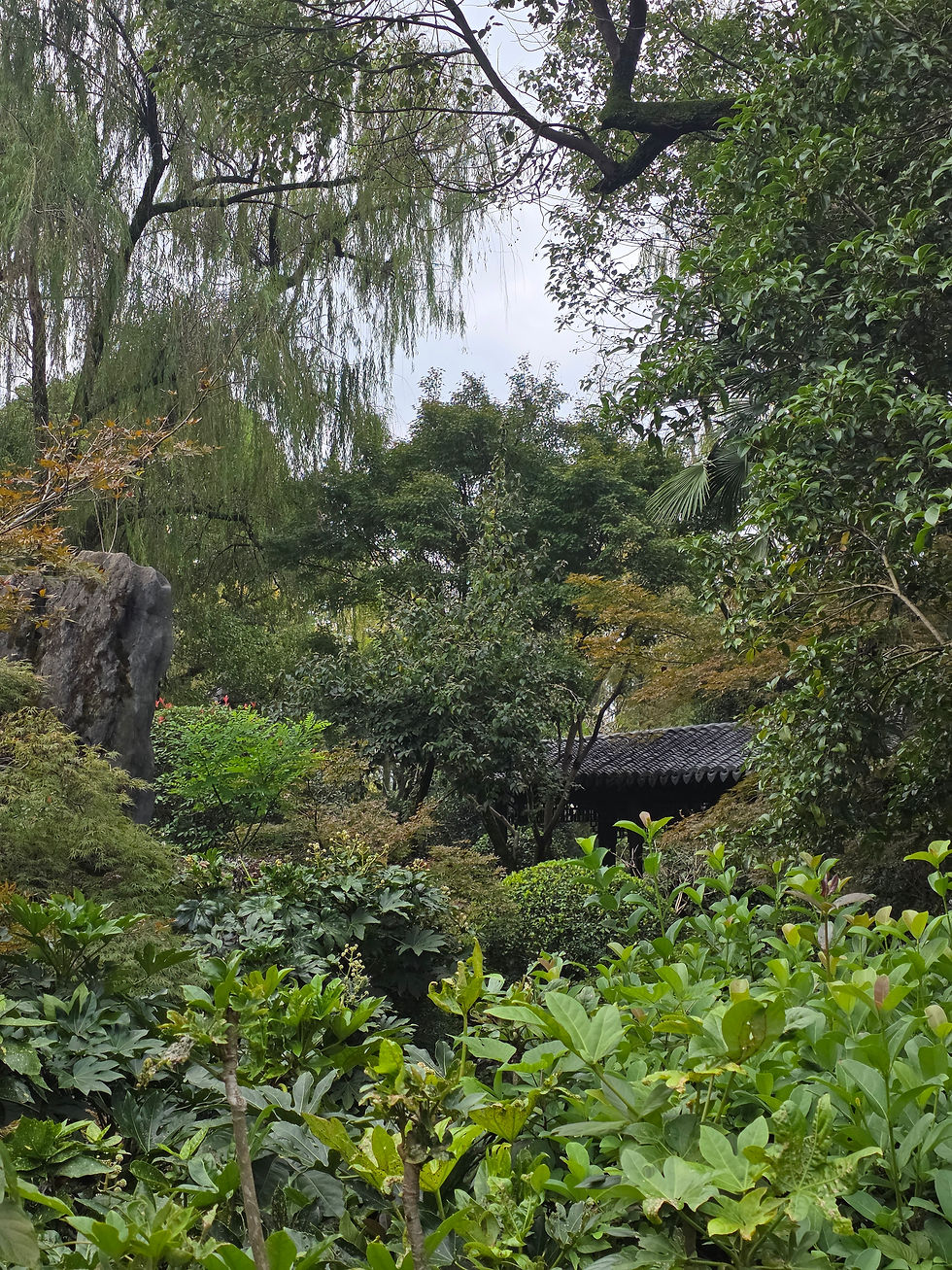
Lush Garden of Four Seasons Hangzhou at West Lake
This architectural arrangement recalls the traditional Chinese garden principle of jiejing (借景), or "borrowed scenery," an aesthetic approach that incorporates the surrounding landscape into a designed space. Rather than viewing architecture as an isolated object, visitors are encouraged to observe nature from different perspectives through doors, windows, corridors, and courtyards.
Where contemporary luxury hotels often seek to create an immediate impression through grand lobbies or iconic design objects, the architecture here takes the opposite approach. The spaces do not reveal all their beauty at once, instead leaving room for visitors to discover them gradually. Much like the aesthetics of West Lake itself, this hotel reveals more to those who linger.


Indoor Swimming Pool
When a Stroll Through the Garden Becomes a Journey in Itself
At Four Seasons Hangzhou, architecture and gardens are inseparable. Bamboo groves, willow trees, lotus-filled ponds, small waterways, and pavilions blend naturally into the hotel's everyday spaces. Rather than simply decorating the property with beautiful plants, Bill Bensley's landscape design connects water, terrain, vegetation, and architecture into one continuous landscape. Ponds become mirrors reflecting the surrounding buildings, trees gently screen the view, and winding paths allow visitors to experience the garden's changing scenes one after another. The walk from a guest room to a restaurant, the journey to the lobby lounge for a cup of tea, or an aimless stroll around the pond after a meal all become experiences of West Lake in their own right.
The changing seasons are equally important to the experience of the property. In spring, fresh leaves and blossoms bring vitality to the gardens, while summer fills the waterside with lotus flowers and lush greenery. Autumn transforms the colors of the foliage, adding depth to the atmosphere, and winter reveals the lines of bare branches and architecture with greater clarity. One might describe it as the experience of becoming, if only briefly, part of the landscape.

Room of Four Seasons Hangzhou at West Lake
Another Home Nestled Within the Gardens
The guest rooms emphasize the comfort and tranquility of traditional Chinese residential spaces. Timber details, delicate decorative elements, and natural materials create a sense of warmth, while generous proportions provide a feeling of openness. Even the entry-level Garden-View Room offers approximately 63 square meters of space, while the Premier Garden-View Room measures up to approximately 73 square meters. The Garden Terrace Room, also measuring 73 square meters, offers an outdoor area connected to the gardens, allowing guests to experience nature at closer range.
For travelers who value a terrace overlooking the gardens, the Garden Terrace Room is an appealing choice, while those seeking more expansive living areas and greater privacy may wish to explore the suite categories. The 120-square-meter Lotus Suite, 130-square-meter Lagoon Suite, and 140-square-meter West Lake Suite each offer distinct layouts and views. For an even higher degree of privacy, the hotel also offers villas featuring private Chinese gardens, swimming pools, and fitness facilities.


Garden Terrace Room - private garden with a view
Jin Sha: Capturing Hangzhou's Four Seasons on a Plate
Another essential element that makes Four Seasons Hangzhou such a distinctive destination is its gastronomy. The signature Chinese restaurant, Jin Sha (金沙厅), is particularly noteworthy for the way it has developed a strong regional culinary identity over many years, earning considerable acclaim among gastronomes both in China and internationally, and establishing itself as a dining destination in its own right.
Jin Sha was awarded one Michelin star in 2023, when the Michelin Guide made its debut in Hangzhou, and has retained its star every year since. In the Black Pearl Restaurant Guide, one of China's leading gastronomic rating systems, it has received the highest distinction of Three Diamonds for nine consecutive years, from 2018 through 2026. The restaurant was also ranked No. 85 on the extended list of Asia's 50 Best Restaurants 2026.

Jinsha at Four Seasons Hangzhou at West Lake
Executive Chef Wang Yong (王勇) is a master chef with three decades of culinary experience. Born in Jiangxi Province, he developed his culinary expertise in Shanghai before taking the helm at Jin Sha, where he has spent more than 15 years shaping the restaurant's culinary identity. His cuisine is rooted in the culinary traditions of Jiangsu and Zhejiang provinces, collectively known as Jiangzhe cuisine (江浙菜). Zhejiang Province, blessed with a rich natural environment where rivers, lakes, the sea, and mountains converge, has developed a diverse range of ingredients and culinary traditions. Its defining characteristics include delicate knife skills, cooking techniques that preserve the natural flavors of ingredients, and a balance of lightness and deep umami that evolves with the seasons. Chef Wang selects ingredients at their seasonal peak, refining cooking methods and compositions according to their individual characteristics to reinterpret regional cuisine through a more contemporary sensibility.
One of Jin Sha's signature dishes, Braised Pork Belly and Abalone, illustrates this approach particularly well. The dish combines traditional Chinese braised pork belly, slowly cooked to achieve a tender texture, with abalone, bringing together the depth of a time-honored preparation and the luxurious flavors of a prized ingredient. Another signature, Jin Sha Crispy Chicken, presents a refined interpretation of a familiar chicken dish through the contrast between its crisp skin and succulent meat. Steamed Sanmen Crab with Huadiao Wine (花雕酒) similarly brings together the flavors of regional seafood and traditional Chinese fermented rice wine.
A great restaurant allows diners to understand the culture and nature of a region through a single meal. This is precisely where Jin Sha's value lies. If the hotel's guest rooms and gardens offer a visual experience of Hangzhou's beauty, Jin Sha allows guests to discover the region's terroir, seasons, and centuries-old culinary techniques through taste.

Tea at Jinsha
The Rhythm of Hangzhou, Continued Through a Cup of Tea
It is impossible to speak of Hangzhou without mentioning tea. Longjing Tea (龍井茶), particularly that produced around West Lake, is one of China's most representative green teas and an important part of the region's cultural heritage. Longjing is a traditional pan-fired green tea, cherished for its delicate aroma and gentle flavor. Among its varieties, West Lake Longjing Tea, produced in designated growing areas around the lake, has such a strong regional identity that its geographical origin and production methods are subject to specific regulations.
Enjoying a cup of Longjing tea in the hotel's lobby lounge is an inviting introduction to Hangzhou's traditions in an everyday setting. In Chinese tea culture, drinking tea is also an act of observing aroma and flavor, adjusting water, temperature, and time, and concentrating one's senses on the experience.

Long Jing Tea farm curated by Four Seasons
For those seeking a more immersive exploration, the hotel can arrange tours to nearby tea-growing regions. Traveling from West Lake toward the mountains reveals a succession of meticulously cultivated tea plantations, offering another perspective on Hangzhou amid landscapes covered with tea bushes. Learning about the everyday lives of tea producers and traditional tea-making practices, and tasting tea in the very place where it is grown, brings a different kind of emotional resonance from the pleasures found in the city's glamorous hotels and restaurants.

Boat tour at Four Seasons Hangzhou at West Lake
A Day at West Lake, Inside and Beyond the Hotel
The hotel's location is ideal for exploring the city. Nearby attractions include Quyuan Fenghe (曲院風荷), the Su Causeway, and Hangzhou Botanical Garden, all of which are wonderful places for leisurely walks. The West Lake boat tours operated by the hotel are equally appealing, while the dedicated breakfast-on-a-boat program is particularly worth experiencing. Enjoying breakfast on West Lake is a special occasion that few other hotels can easily replicate.
In the afternoon, it is worth venturing to nearby Lingyin Temple (靈隱寺) and Feilai Peak (飛來峰). These destinations bring together Hangzhou's longstanding Buddhist heritage and its forested mountain scenery, offering a deeper appreciation of the spiritual and cultural dimensions of West Lake.
A Place Where the Art of Staying Transforms the Meaning of Travel
What defines a true destination hotel? At a time when facilities and services across the luxury hospitality industry have reached increasingly comparable standards, what travelers value most is the distinctive emotions and memories that can only be experienced in a particular place. The greatest strength of Four Seasons Hotel Hangzhou at West Lake lies in the intimate connection between the destination of West Lake and the hotel's own spatial identity. A stroll through the gardens becomes an encounter with Jiangnan's landscape traditions; a meal at Jin Sha offers an exploration of Jiangzhe culinary heritage; and a cup of Longjing tea introduces the tea culture of Hangzhou.
The hotel's exceptional level of service is equally important. Through the concierge, guests can arrange cultural experiences and tours, as well as dining and wellness programs tailored to their individual preferences, allowing them to discover Hangzhou's diverse cultural offerings in a natural and seamless way. For these reasons, the hotel retained its Two Michelin Keys in the 2026 Michelin hotel ratings and was also named among Tatler Best's 100 Best Hotels in Asia-Pacific that same year. These international accolades serve as objective indicators of the property's hospitality and overall guest experience.

For centuries, West Lake has invited countless visitors to contemplate the meaning of beauty. Its landscape, where water and mountains, gardens and architecture, time and seasons exist in harmony, seems to offer a subtly different answer with every passing moment. Here, one can become part of the surrounding scenery, treasure moments that linger in memory rather than those consumed in the rush of travel, and discover an answer of one's own.
댓글