A Taste of Bali: Dulang at The St. Regis Bali Resort
Having come all the way to Bali, I thought I should, of course, eat Balinese food. Dulang at The St. Regis Bali Resort is a place where refined beauty and a genuine sense of local authenticity coexist. Set within the polished luxury of the St. Regis in Nusa Dua, the restaurant brings together Balinese food, ritual, music and dance in one continuous experience.


The name “Dulang” refers to a tray or ceremonial platform traditionally used in Bali to hold food or offerings. The restaurant sits amid the resort’s lush gardens, housed within a Balinese-style gazebo intricately carved in wood. In this space, where the boundaries between indoors and outdoors are deliberately loose, tropical plants, textiles, wood and soft lighting come together. As the evening deepens, the sense of Bali’s unhurried rhythm becomes more pronounced than the grandeur of the resort itself. After enjoying a light aperitif in the main building, we slowly walked over to Dulang, and arriving there felt almost as though we had briefly stepped outside the resort and into a special local home. As soon as we arrived, we were invited to wash our hands with flower-infused water poured from a large vessel filled with blossoms. It immediately lifted my mood. That distinctly Balinese sense of gracious hospitality heightened the anticipation even before the meal began.

For Asians, myself included as a Korean, the idea of sharing an entire table of dishes is an extremely familiar way of eating. Each person takes some rice, while a variety of dishes are placed in the centre to be shared and enjoyed together. The Indonesian dining experience at Dulang follows a similar philosophy. Rather than adopting the conventions of fine dining simply because it is located within a luxury hotel, the restaurant centres its experience around Rijsttafel, allowing guests to encounter a broad range of Balinese dishes across a single table. The format of Rijsttafel itself developed during the colonial era in the Dutch East Indies, but Dulang interprets it through a contemporary perspective on Balinese royal feasts and the island’s communal dining culture. Rather than presenting a single dish as an imposing main course, rice is placed at the heart of the table, surrounded by different meats, seafood, vegetables, sambals and spice-driven dishes, revealing the breadth of Balinese cuisine over the course of one dinner.

From the very beginning, the meal makes you conscious of being in Bali. We started the evening with Loloh Cemcem, a traditional drink made with fresh herbs grown in the hotel’s own garden. Originating from Penglipuran Village in the Bangli region, the drink is centred around cemcem leaves and has a distinctive combination of sweetness, acidity and saltiness. Several varieties of local sambal and crackers followed. I ate these crackers constantly throughout my time in Indonesia and somehow never grew tired of them. My hand always reached for another.
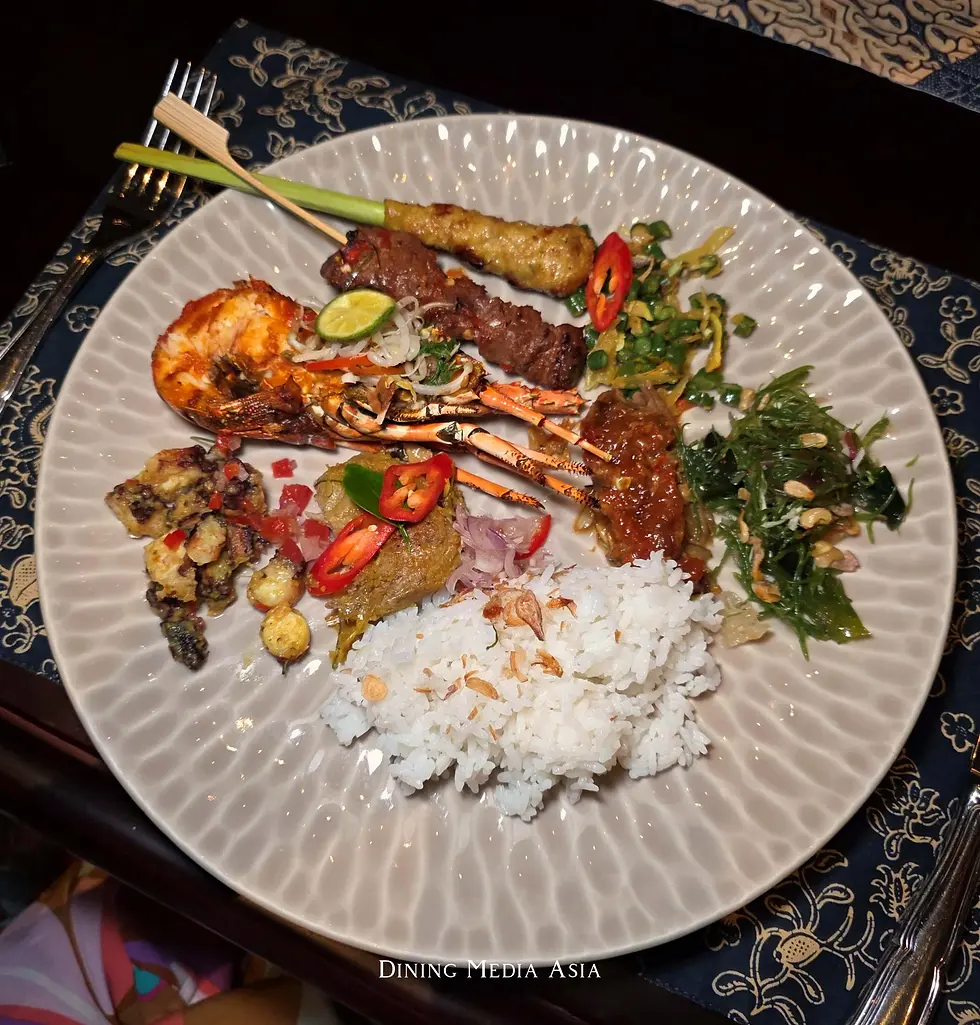
The dishes that followed felt like a small culinary map of Bali, tracing particular regions and cooking traditions. Soto Sampi Karangasem, from the Karangasem region, paired a clear, deeply flavoured beef broth with vegetables. In contrast to the common perception of Indonesian cuisine as being dominated by assertive spices, its delicacy and clarity were particularly memorable. And then, finally, came the main event. Presented together on a rotating dulang was a colourful selection of dishes: sate lilit made with minced chicken; sweet and spicy beef sate plecing; lobster with sambal matah; Timbungan Bebek, duck cooked inside bamboo; octopus with tomato sambal; bonito fish cooked in banana leaf with Balinese spices; and vegetable dishes including lawar and plecing kangkung. I take food very seriously, of course, but even my eight- and six-year-old children enjoyed the meal immensely and ate with genuine enthusiasm.
I particularly liked this style of dining. Not simply because it allowed us to taste many different things at once, but because local restaurants in Bali often specialise in one or two signature dishes according to their region or principal ingredients. Along the coast, fish and seafood naturally take centre stage, while inland areas tend to feature dishes built around duck, pork and spices. At Dulang, these different regional styles come together on a single table. Rather than reducing Balinese cuisine to a handful of dishes already familiar to visitors, such as babi guling or ayam betutu, it seemed to show just how complex and layered the island’s food culture actually is. For that reason, Dulang’s Rijsttafel felt less like “local food made luxurious” and more like a carefully considered curation of Bali’s culinary landscape, condensed into a form that introduces the region to a first-time visitor.
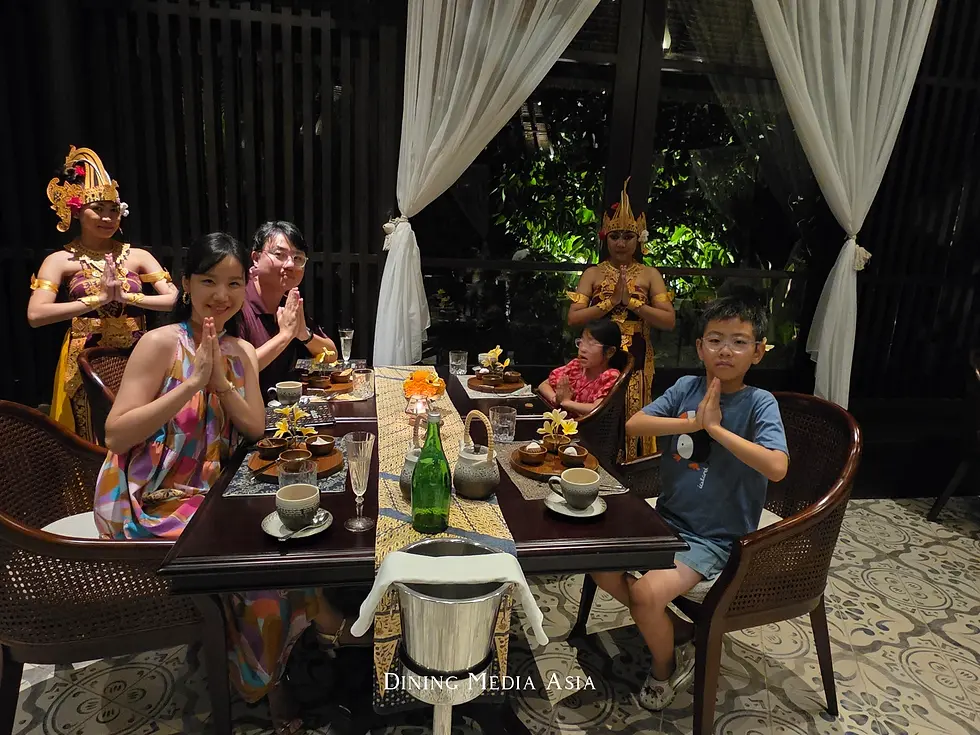
The performances throughout the meal were as memorable as the food itself. The clear tones of the traditional Balinese bamboo instrument known as the rindik, accompanied by the sound of the suling flute, filled the space, while two dancers in traditional dress moved between the tables, performing at remarkably close range and shaping the atmosphere of the evening. I particularly enjoyed being able to share a meal with my children while allowing them to experience the visual and aural dimensions of Balinese culture so naturally.


Dessert remained faithful to the Balinese theme until the very end. Together, they seemed to distil elements of Bali’s food and drink culture into the final part of the meal. It was an experience shaped by careful consideration of how an existing culture might best be presented: good local ingredients, Balinese spices, longstanding dishes, the rituals surrounding a meal, music and dance, and the polished service of a luxury hotel all enhanced one another over the course of a single evening.
At a resort such as The St. Regis Bali Resort, which functions as a destination in itself, it is entirely possible to spend several days without ever leaving the property. But a truly good resort should not isolate its guests from the world beyond its gates. Instead, even from within, it should continually remind them of where they have travelled to. Dulang does exactly that. I loved the memory of sitting in a Balinese garden on a summer evening, tasting sambal, listening to bamboo instruments, watching traditional dance with my children, and sharing dishes from different parts of the island together. If I were asked what the most important role of local dining within a luxury hotel should be, perhaps the answer would be this: to help travellers understand more deeply where they are, through food. Dulang does precisely that, and does it quite beautifully.
댓글