A Deep Dive into the Michelin Key
Michelin’s official hotel guide, the Michelin Key—everything distilled into one piece.

In hospitality today, the key word is experience. And at the peak of that experience lies the stay. It doesn’t have to be a hotel; any format that allows you to briefly live somewhere has become the trend. Food, fashion, and hotels are all striving to amplify this experiential value.
Over the past decade, “luxury experience” has expanded rapidly—from fashion into dining, from dining into lifestyle and living. High-end fashion, fine dining, luxury travel, and hotel clientele increasingly overlap, forming a single continuum. Once upon a time, a fashion devotee didn’t necessarily understand fine dining, and someone deeply knowledgeable about food might not have cared much for hotels. Today, while each industry still has its core loyalists, the number of “overlapping customers” who actively engage across fashion, food, and stay has undeniably increased. Luxury fashion houses push to open premium dessert shops and fine dining restaurants, while hotels invest heavily in top-tier F&B. Supply and demand now move toward the same trend.
On the ground, there are reasons for this shift: strategic changes in global luxury brands, lifestyle transformations brought on by COVID and remote work, the normalization of social media saturated with performative “moments,” and even currency depreciation—all of these have recalibrated the psychological value of a “stay.” Watching the industry from the frontline—collaborating with restaurants, hotels, brands—the past ten years felt like redefining what “luxury experience” truly means. And standing in the middle of that storm, sometimes without even an umbrella, I felt the change viscerally. So let’s begin with the topic I’ve discussed most passionately with many people: the Michelin Key.

The Michelin Key: the “Michelin Star” for Hotels
Do we really need another luxury hotel rating? When Michelin acquired the boutique/luxury hotel booking platform Tablet Hotels in 2018, was this simply a business move? Governments already classify hotels using tourism criteria, and Forbes has long had its own hotel rating system—so what makes the Michelin Key different?
Its branding cannot be separated from the Michelin Star. Both use a base selection and a 1–3 tier scale. And just like the Star, Michelin emphasizes that the meaning of one Key is the same anywhere in the world.
Just as Michelin inspectors evaluate restaurants on temperature, ingredient curation, technique, consistency, service, and narrative flow, Michelin has now published detailed criteria for hotels. These criteria go far beyond counting pools or restaurants—the traditional 3-star, 5-star metrics. True excellence manifests in countless ways. Travelers who value their stay seek something beyond the simple “worth the price.” They want a personal reason—a stay where time and narrative move in harmony. Even among hotels with similar specifications and scale, true 3 Key properties are rare. And that rarity fuels consumer interest.
So Michelin’s decision in 2025 to award “Keys” was symbolic. “Just as the Star signifies outstanding cuisine,” Michelin states, “the Key signifies an outstanding stay.” And this outstanding is defined through five universal pillars: excellence in architecture and interior design, quality and consistency of service, overall character and personality, value for price, and meaningful contribution to the local community and environment. Only hotels that satisfy all five can earn a Key.


Michelin Key Evaluation Criteria
The five pillars show that a hotel must be more than hardware. Were the rating purely hardware-based, the world would have thirty times more 3 Key hotels. Instead, Michelin evaluates the continuity of the entire stay—the natural flow from arrival to departure. More than isolated moments of kindness, Michelin looks at consistent standards from beginning to end. Reservation, check-in, housekeeping, spa, room service, check-out—all must resonate with the same tone. What matters is not occasional emotional episodes but stable, systemic excellence.
What You Can Observe On-Site
First, design. It is undoubtedly one of the most intuitive factors influencing guest satisfaction. But Michelin isn't just impressed by expensive materials; it asks how the hotel translates the aesthetics of its location into architectural and sensory language. It's not about using local materials or displaying local artwork per se—it’s about whether the light, texture, sound, and scent answer the question, “Why must this hotel be here?”
Four Seasons Hotel Firenze is a definitive example: a 15th-century Renaissance palazzo restored over seven years. Naturally, such heritage brings immense “sense of place.” It is a 3 Key hotel. Sitting in my room, looking out over a private 16th-century garden and centuries-old trees, I felt I was experiencing Florence’s history with my entire body.

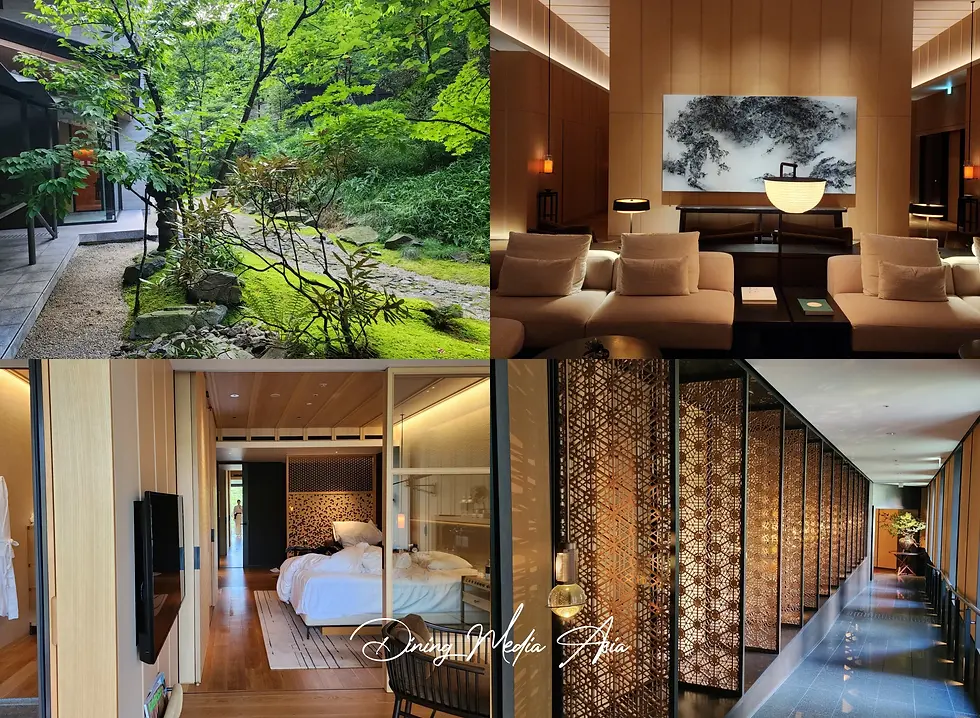
But heritage buildings aren’t the only way to achieve placefulness. Even new hotels can curate region, culture, and beauty. The Ritz-Carlton Nikko, which opened in July 2020, proved this. Its rooms transcend the “newly built freshness”: large sumi-ink landscapes painted with mineral pigments depicting Nikko’s mountains and lakes; pale birchwood walls; minimalist red-tube panels; kumiko-style joinery partitions assembled without glue; tatami-textured wall surfaces; spa areas built from Oya stone and cedar. The more you look, the deeper the beauty becomes—a refined expression of local identity. Sitting on the terrace overlooking shimmering Lake Chuzenji, sipping the green tea prepared daily, feels like embodying Nikko itself.
Second: Quality and Consistency of Service. This isn't about “ace staff” or unconditional friendliness. Brands endure, employees change—this is reality. So true consistency relies on systems. If rotations, data, and processes are well designed, even after ten years—when every employee might have changed—the hotel can still deliver the same emotional signature. Banyan Tree Macau exemplifies this: with impeccable service protocols shaped by GM Joanne Chan (awarded Travel + Leisure’s 2025 “GM of the Year”) and her butler team. Kindness is basic; what moves guests is being treated like “a remembered individual”—something only robust systems and detailed guest records can achieve.

Third: Brand Coherence. Does the property’s personality resonate with the hotel brand? Does the brand’s emotional DNA permeate the welcome tea temperature, room card design, even the stroke width of the typography? True excellence lies in stitching brand and property character into one seamless experience.
Fourth: Value for Price. Luxury doesn’t automatically justify its price. Two hotels with the same ADR (Average Daily Rate) can deliver vastly different perceived value depending on the density of curation: chef’s tables, local art tours, nature programs. Bulgari Resort Bali competes with many high-end escapes, yet its intensely “Bulgari and Bali” curation sets it apart. Nearly every activity is fully private—villa-dedicated butlers, private painting sessions, yoga, cultural excursions, meditation rituals. Unlike resorts where classes are shared among guests, Bulgari designs activities so you often forget any other guests exist. For travelers who value privacy, the emotional value is incomparable.

Fifth: Social Contribution—Hotels as Platforms for Place. Michelin evaluates how hotels contribute to their region and environment. This means seeing hotels as platforms that connect travelers to community and nature. Partnerships with local producers, artisans, and artists; environmental initiatives; community engagement—they must be part of the hotel’s operating core, not PR.
Recently, while dining with the JW Marriott Seoul team, they said something memorable: “Our rooms face the river, but also the hospital. And we realized: how must the hotel look from the viewpoint of patients looking out from their beds?” That reflection led their chefs to bake cookies and deliver them to patients during the holidays—a small gesture born from genuine thought.
The same applies to sustainability. Michelin asks whether the hotel’s operations breathe with its region. Take Amanemu, a 2016 opening in Japan’s Ise-Shima National Park. It goes beyond a luxury façade and functions as part of the local socio-ecological fabric: sourcing most ingredients from regional farmers and producers; prioritizing local hiring with fair wages and staff education; embedding community programs and conservation activities into daily operations rather than PR; and offering experiences linked to the local ama divers and pearl-culturing heritage of Ago Bay. This 3 Key hotel contributes tangibly to its region and generates meaningful social value.
Michelin 1 Key, 2 Keys, 3 Keys
If you're familiar with Michelin Stars, the Key is intuitive:• 1 Key = “A very special stay”• 2 Keys = “An exceptional stay”• 3 Keys = “A truly extraordinary and unparalleled stay.” It’s not about quantity—it’s about class of experience. Even hotels under the same luxury brand will differ in Key rating depending on how well their service flows, and how deeply their locality is embedded in both hardware and narrative. The 2025 selection broadens this spectrum across cities, landscapes, and resort destinations.
The First Global “Map” of 2025
On October 8, 2025, Michelin unveiled its first global Key selection in Paris, identifying the finest stays among 7,000 guide-listed hotels. Previously, hotel tabs existed in some country-specific Michelin sites (like Singapore), but this marked the formal establishment of the Key as an annual global benchmark.
Notably, Michelin placed grand urban icons, destination resorts*, and culturally rooted boutique hotels on equal footing. This reflects Michelin’s editorial stance: evaluation based not on popularity but on anonymous inspector visits.(*Destination resorts are properties where the resort itself is the purpose of travel—think InterContinental Danang for Korean travelers.)
How Is This Different from Forbes and other guides?
The emergence of the Michelin Key doesn’t replace Forbes Travel Guide. Forbes uses up to 900 micro-criteria to assess operations, while the Michelin Key observes holistic experience and sense of place. Both rely on expert assessment, not public voting. Industry players can now triangulate perspectives: Michelin Keys, Forbes ratings, World’s 50 Best Hotels (industry voting), and consumer-based awards or OTA scores. Hospitality excellence is multifaceted, and each evaluates a different layer.
In 2018, Michelin acquired Tablet Hotels. Since then, its hotel guide and booking platform have integrated seamlessly. The Key is now a strategic layer in Michelin’s expansion into hotels. Yet, because Michelin evaluates hotels while simultaneously driving bookings through its system, the ethical balance between critique and commerce will be a key topic as the Key seeks long-term credibility. Michelin emphasizes clear criteria and anonymous inspections—but trust is built over time. As annual Key selections accumulate, and as the industry sees consistency, the Key may naturally evolve into an editorial benchmark, not merely a “hot list.” Our role is to watch closely—with critical distance and affectionate curiosity—as this new chapter unfolds.
댓글